SHAWORDS
Sack of Somnath

Sack of Somnath

Sack of Somnath

author
5Quotes

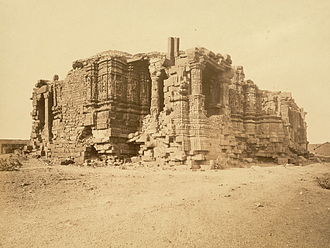
The Sack of Somnath in 1026 was a military campaign orchestrated by Mahmud of Ghazni, the ruler of the Ghaznavid Empire, against the Chaulukya dynasty of Gujarat. This is considered Mahmud's fifteenth invasion of India, which saw strategic captures and battles that culminated in the destruction of the revered Somnath Temple. Facing staunch resistance, Mahmud's forces emerged victorious, resulting

Popular Quotes

5 total
Quote
"The Hindus used to go on pilgrimage to it whenever there was an eclipse of the moon, and would then assemble there to the number of more than a hundred thousand. They believed that the souls of men used to meet there after separation from the body, and that the idol used to incorporate them at its pleasure in other bodies in accordance with their [p. 134] doctrine of transmigration. The ebb and flow of the tide was considered to be the worship paid to the idol by the sea. Everything of the most precious was brought there as offerings, and the temple was endowed with more than 10,000 villages. There is a river (the Ganges) which is held sacred, between which and Somnat the distance is 200 parasangs. They used to bring the water of this river to Somnat every day, and wash the temple with it. A thousand brahmans were employed in worshipping the idol and attending on the visitors, and 500 damsels sung and danced at the door-all these were maintained upon the endowments of the temple. The edifice was built upon fifty-six pillars of teak, covered with lead. The shrine of the idol was dark, but was lighted by jewelled chandeliers of great value. Near it was a chain of gold weighing 200 mans. When a portion (watch) of the night closed, this chain used to be shaken like bells to rouse a fresh lot of brahmans to perform worship."
Sack of SomnathSack of Somnath
Quote
"“It is said that the temple of Somnat was built by one of the greatest Rajas of India. The idol was cut out of solid stone, about five yards in height, of which two were buried in the earth. Mahmud, as soon as his eye fell on this idol, lifted up his battle-axe with much anger, and struck it with such force that the idol broke into pieces. The fragments of it were ordered to be taken to Ghaznin, and were cast down at the threshold of the Jami’ Masjid’, where they are lying to this day. It is a well-authenticated fact that when Mahmud was about to destroy the idol, a crowd of Brahmans represented (to his nobles) that if he would desist from the mutilation they would pay several crores of gold coins into his treasury. This was agreed to by many of the nobles, who pointed out to the Sultan that he could not obtain so much treasure by breaking the image, and that the proffered money would be very serviceable. Mahmud replied, “I know this, but I desire that on the day of resurrection I should be summoned with the words, ‘where is the Mahmud who broke the greatest of the heathen idols’ rather than by these: ‘Where is that Mahmud who sold the greatest of the idols to the infidels for gold?’ ” Then Mahmud demolished the image, he found in it so many superb jewels and rubies, that they amounted to, and even exceeded as hundred times the value of the ransom which had been offered to him by the Brahmans. “According to the belief of the Hindus, all the other idols in India held the position of attendants and deputies of Somnat. Every night this idol was washed with ‘fresh’ water brought from the Ganges, although that river must be more than two hundred parasangs [p. 54] distant. This river flows through the eastern part of India, and is held very sacred by the Hindus. They throw the bones of their dead into it."
Sack of SomnathSack of Somnath
Quote
"When the Sultan Yaminu-d Daula Mahmud bin Subuktigin went to wage religious war against India, he made great efforts to capture and destroy Somnat, in the hope that the Hindus would then become Muhammadans. He arrived there in the middle of Zi-l kada, 416 A.H. (December, 1025 A.D.). The Indians made a desperate resistance. They would go weeping and crying for help into the temple, and then issue forth to battle and fight till all were killed. The number of the slain exceeded 50,000. The king looked upon the idol with wonder, and gave orders for the seizing of the spoil, and the appropriation of the treasures. There were many idols of gold and silver and vessels set with jewels, all of which had been sent there by the greatest personages in India. The value of the things found in the temples of the idols [p. 135] exceeded twenty thousand thousand dinars. When the king asked his companions what they had to say about the marvel of the idol, and of its staying in the air without proper support, several maintained that it was upheld by some hidden support. The king directed a person to go and feel all around and above and below it with a spear, which he did, but met with no obstacle. One of the attendants then stated his opinion that the canopy was made of loadstone, and the idol of iron, and that the ingenious builder had skilfully contrived that the magnet should not exercise a greater force on anyone side-- hence the idol was suspended in the middle. Some coincided, others differed. Permission was obtained from the Sultan to remove some stones from the top of the canopy to settle the point. When two stones were removed from the summit the idol swerved on one side, when more were taken away it inclined still further, until at last it rested on the ground."
Sack of SomnathSack of Somnath

Similar Authors & Thinkers