Quote
"The living will envy the dead."
N
Nuclear war"A preventive war, to my mind, is an impossibility today. How could you have one if one of its features would be several cities lying in ruins, several cities where many, many thousands of people would be dead and injured and mangled, the transportation systems destroyed, sanitation implements and systems all gone? That isnt preventive war; that is war."
Nuclear warfare, also known as atomic warfare, is a military conflict or prepared political strategy that deploys nuclear weaponry. Nuclear weapons are weapons of mass destruction; in contrast to conventional warfare, nuclear warfare can produce significantly more destruction in a much shorter time and can have a long-lasting radiological result. A large nuclear exchange would kill hundreds of mil
"The living will envy the dead."
"A strange game. The only winning move is not to play. How about a nice game of chess?"
"Let us imagine how many people would die if war breaks out. There are 2.7 billion people in the world, and a third could be lost. If it is a little higher it could be half ... I say that if the worst came to the worst and one-half dies, there will still be one-half left, but imperialism would be razed to the ground and the whole world would become socialist. After a few years there would be 2.7 billion people again."
"The double horror of two Japanese city names grew for me into another kind of double horror; an estranging awareness of what the United States was capable of, the country that five years before had given me its citizenship; a nauseating terror at the direction the natural sciences were going. Never far from an apocalyptic vision of the world, I saw the end of the essence of mankind an end brought nearer, or even made, possible, by the profession to which I belonged. In my view, all natural sciences were as one; and if one science could no longer plead innocence, none could."
"In 1945, therefore, I proved a sentimental fool; and Mr. Truman could safely have classified me among the whimpering idiots he did not wish admitted to the presidential office. For I felt that no man has the right to decree so much suffering, and that science, in providing and sharpening the knife and in upholding the ram, had incurred a guilt of which it will never get rid. It was at that time that the nexus between science and murder became clear to me. For several years after the somber event, between 1947 and 1952, I tried desperately to find a position in what then appeared to me as a bucolic Switzerland,—but I had no success."
"There is no evil in the atom; only in men’s souls."
"In the life of the mass-order, the culture of the generality tends to conform to the demands of the average human being. Spirituality decays through being diffused among the masses when knowledge is impoverished in every possible way by rationalisation until it becomes accessible to the crude understanding of all."
"I say this to you because we Spaniards are a forgetful people, because we are used to living for the moment, because we do not look back, because we do not know how to see the chain of heroes, because we do not contemplate the sum of sacrifices."
 Francisco Franco
"Sharon Tate was my best friend. Once, we were roommates. She introduced me to my husband. She was the godmother to my baby daughter who is named for her. In the six years time that I knew her, she never said an unkind word about anyone."
"Long time to see. (VS: Tapion)"
"Most mathematicians prove what they can, von Neumann proves what he wants." Once in a discussion about the rapid growth of mathematics in modern times, von Neumann was heard to remark that whereas thirty years ago a mathematician could grasp all of mathematics, that is impossible today. Someone asked him: "What percentage of all mathematics might a person aspire to understand today?" Von Neumann went into one of his five-second thinking trances, and said: "About 28 percent."
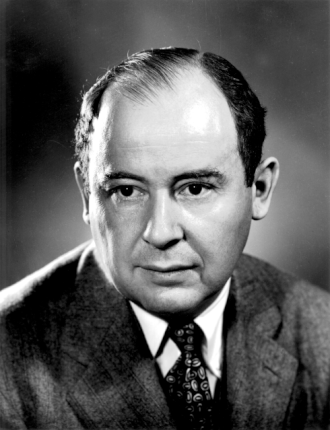 John von Neumann
"Children must be free to think in all directions irrespective of the peculiar ideas of parents who often seal their childrens minds with preconceived prejudices and false concepts of past generations. Unless we are very careful, very careful indeed, and very conscientious, there is still great danger that our children may turn out to be the same kind of people we are."