SHAWORDS

An attempt is being made by the Russians in Berlin to build up a quasi — Berlin

HomeBerlinQuote
"An attempt is being made by the Russians in Berlin to build up a quasi-Communist party in their zone of Occupied Germany by showing special favors to groups of left-wing German leaders. At the end of the fighting last June, the American and British Armies withdrew westwards, in accordance with an earlier agreement, to a depth at some points of 150 miles upon a front of nearly four hundred miles, in order to allow our Russian allies to occupy this vast expanse of territory which the Western Democracies had conquered. If now the Soviet Government tries, by separate action, to build up a pro-Communist Germany in their areas, this will cause new serious difficulties in the British and American zones, and will give the defeated Germans the power of putting themselves up to auction between the Soviets and the Western Democracies. Whatever conclusions may be drawn from these facts - and facts they are - this is certainly not the Liberated Europe we fought to build up. Nor is it one which contains the essentials of permanent peace."
Berlin
Berlin
Berlin
author15 quotes

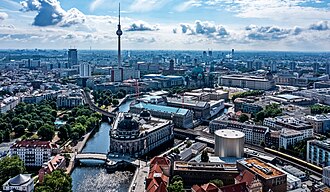
Berlin is the capital of Germany, as well as its largest city by both area and population. With 3.7 million inhabitants, it has the highest population within its city limits of any city in the European Union. The city is also one of the states of Germany, being the third-smallest state in the country by area. Berlin is surrounded by the state of Brandenburg, bordering Brandenburg's capital Potsdam

More by Berlin

View all →
Quote
"To illustrate how dramatically populations can displace each other over time, the historian E.M. Kulischer once reminded his readers that in A.D. 900 Berlin had no Germans, Moscow had no Russians, Budapest had no Hungarians, Madrid was a Moorish settlement, and Constantinople had hardly any Turks. He added that the Normans had not yet settled in Great Britain and before the sixteenth century there were no Europeans living in North or South America, Australia, New Zealand, or South Africa."
BerlinBerlin
Quote
"And for us in this country to think of having, for example, a dictatorship—a popular form of government in many countries to-day—would, on our part, be an act of consummate cowardice, an act of surrender, of throwing in our hands, a confession that we were unable to govern ourselves...In this country we do not want what I call the "get-rich-quick" mind. Speed and efficiency are very good things, and they are, perhaps, the idols of this generation. But they do not necessarily go together. Acceleration, as I have often said, is not a synonym for civilisation. It is quite true the State coach of this country may be going through heavy ground, the wheels may be creaking; but are you quite sure that the wheels of the State coach are not creaking to-day in Moscow, in Berlin, in Vienna? Are you quite certain that they are not creaking even in the United States of America?"
BerlinBerlin
Quote
"Few areas of the national life of those Western European countries failed to benefit from the decades of parasitic exploitation of the colonies. One Nigerian, after visiting Brussels in 1960, wrote: “I saw for myself the massive palaces, museums and other public buildings paid for by Congo ivory and rubber.” In recent times, African writers and researchers have also been amazed to find the amount of looted African treasure stacked away in the ; and there are comparable if somewhat smaller collections of African art in Paris, Berlin, and New York. Those are some of the things which, in addition to monetary wealth, help to define the metropoles as developed and “civilized.”"
BerlinBerlin
Quote
"It is true to say that Berlin had far fewer memorials associated with colonialism than imperial cities such as London or Paris. Two memorial stones Two memorial stones and one obelisk were erected to the memory of those soldiers who died in the colonial wars in China and German South-West Africa. Although Imperial Germany saw a major debate about a larger memorial for all Germans who died for the fatherland in the colonies, no specific plans were realized before the outbreak of war in 1914. A central memorial to the memory of the German colonies was only erected in 1932, and then it was built in Bremen and not in Berlin. However, the capital of the imperial nation saw the creation of an “African quarter” in Berlin Wedding. In 1899 the first two streets were named Kameruner Strasse and Togostrasse. 21 other names followed, names of colonies, of particular places in colonies, of famous colonizers and colonial generals. The renaming of streets with a colonial theme continued into the 1920s, demonstrating the strength and the appeal of colonial demonstrating the strength and the appeal of colonial revisionism in the Weimar Republic."
BerlinBerlin