Quote
"Whether communism is partial or complete, political economy is no more tolerant of it than it is of monopoly, of which it is merely an extension."
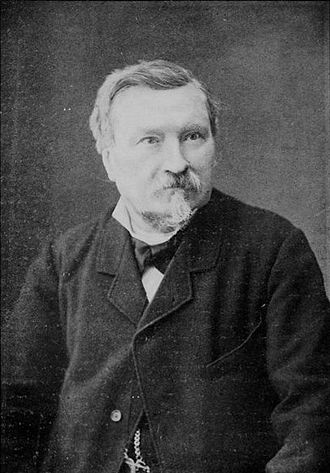 Gustave de Molinari
"Because one fine day they took it into their heads to question and to reason, and in questioning, in reasoning, they discovered that their governors governed them no better than they, simpl[e] mortals out of communication with Providence, could have done themselves.It was free inquiry that demonetized the fiction of divine right, to the point where the subjects of monarchs or of aristocracies based on divine right obey them only insofar as they think it in their own self-interest to obey them."
Gustave de Molinari was a Belgian political economist and French Liberal School theorist associated with French laissez-faire economists such as Frédéric Bastiat and Hippolyte Castille.
Gustave de Molinari was a Belgian political economist and French Liberal School theorist associated with French laissez-faire economists such as Frédéric Bastiat and Hippolyte Castille.
View all quotes by Gustave de Molinari"Whether communism is partial or complete, political economy is no more tolerant of it than it is of monopoly, of which it is merely an extension."
Gustave de Molinari"In all cases, for all commodities that serve to provide for the tangible or intangible needs of the consumer, it is in the consumers best interest that labor and trade remain free, because the freedom of labor and of trade have as their necessary and permanent result the maximum reduction of price."
Gustave de Molinari"Suppose that a man found his person and his means of survival incessantly menaced […]Even though this man might be asked to surrender a very considerable portion of his time and of his labor to someone who takes it upon himself to guarantee the peaceful possession of his person and his goods, wouldnt it be to his advantage to conclude this bargain?Still, it would obviously be no less in his self-interest to procure his security at the lowest price possible."
Gustave de Molinari"The production of security should, in the interests of the consumers of this intangible commodity, remain subject to the law of free competition. … [N]o government should have the right to prevent another government from going into competition with it, or to require consumers of security to come exclusively to it for this commodity."
Gustave de Molinari"In the entire world, there is not a single establishment of the security industry that is not based on monopoly or on communism. […] Political economy has disapproved equally of monopoly and communism in the various branches of human activity, wherever it has found them. Is it not then strange and unreasonable that it accepts them in the security industry?"
Gustave de Molinari"Only his early death had prevented Frédéric Bastiat from writing a treatise on “social harmonies” — as a follow-up work on his Economic Harmonies (1850). But his follower Gustave de Molinari published a great number of monographs dealing with virtually all of the contemporary social and political problems of France, as well as with fundamental problems of social interpretation and with the sociology of religion. His writings had a decisive impact on one of the greatest champions of the new marginal-utility approach. The Italian economist Vilfredo Pareto was a disciple of Léon Walras and a great admirer of Gustave de Molinari. Right from his first systematic exposition of economic science in Cours dEconomie Politique (1896), Pareto applied Walrasian techniques of analysis to Molinarian themes. He applied marginal-utility theory and the theory of general equilibrium to explain spoliation, aristocracy and the circulation of elites, economic interests and class struggle, and the relationship between doctrines and social science."
Gustave de Molinari