Quote
"Magnificent spectacle of human happiness."
S
Sydney Smith"Bishop Berkeley destroyed this world in one volume octavo; and nothing remained after his time, but mind — which experienced a similar fate from the hand of Mr. Hume, in 1737."
Sydney Smith was an English writer and Anglican clergyman, mainly famous for his wit. Besides his energetic parochial work, he was known for his writing and philosophy, founding the Edinburgh Review, lecturing at the Royal Institution and his rhyming salad dressing recipe.
"Magnificent spectacle of human happiness."
"My idea of heaven is, eating pâté de foie gras to the sound of trumpets."
"Have the courage to be ignorant of a great number of things, in order to avoid the calamity of being ignorant of everything."
"It is the greatest of all mistakes to do nothing because you can only do little."
"Take short views, hope for the best, and trust in God."
"The object of preaching is, constantly to remind mankind of what mankind are constantly forgetting; not to supply the defects of human intelligence, but to fortify the feebleness of human resolutions."
"In the life of the mass-order, the culture of the generality tends to conform to the demands of the average human being. Spirituality decays through being diffused among the masses when knowledge is impoverished in every possible way by rationalisation until it becomes accessible to the crude understanding of all."
"I say this to you because we Spaniards are a forgetful people, because we are used to living for the moment, because we do not look back, because we do not know how to see the chain of heroes, because we do not contemplate the sum of sacrifices."
 Francisco Franco
"Sharon Tate was my best friend. Once, we were roommates. She introduced me to my husband. She was the godmother to my baby daughter who is named for her. In the six years time that I knew her, she never said an unkind word about anyone."
"Long time to see. (VS: Tapion)"
"Most mathematicians prove what they can, von Neumann proves what he wants." Once in a discussion about the rapid growth of mathematics in modern times, von Neumann was heard to remark that whereas thirty years ago a mathematician could grasp all of mathematics, that is impossible today. Someone asked him: "What percentage of all mathematics might a person aspire to understand today?" Von Neumann went into one of his five-second thinking trances, and said: "About 28 percent."
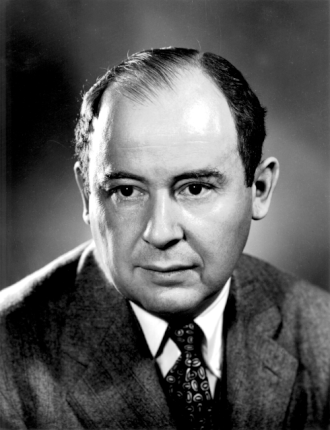 John von Neumann
"Children must be free to think in all directions irrespective of the peculiar ideas of parents who often seal their childrens minds with preconceived prejudices and false concepts of past generations. Unless we are very careful, very careful indeed, and very conscientious, there is still great danger that our children may turn out to be the same kind of people we are."