"Remember this, and take courage. Take it to heart, you transgressors. Remember the former things of long ago, That I am God, and there is no other. I am God, and there is no one like me. From the beginning I foretell the outcome, And from long ago the things that have not yet been done. I say, ‘My decision will stand, And I will do whatever I please.’ I am calling a bird of prey from the sunrise, From a distant land the man to carry out my decision. I have spoken, and I will bring it about. I have purposed it, and I will also carry it out."
Come, now, and let us set matters straight between us,” says Jehovah. — The Bible
"Come, now, and let us set matters straight between us,” says Jehovah. “Though your sins are like scarlet, They will be made as white as snow; Though they are as red as crimson cloth, They will become like wool."

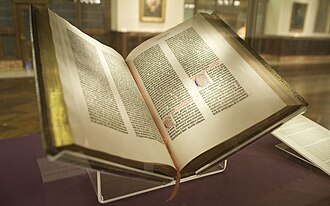
The Bible is a collection of religious texts that are central to Christianity and Judaism, and esteemed in other Abrahamic religions such as Islam. The Bible is an anthology originally written in Hebrew and Koine Greek. The texts include instructions, stories, poetry, letters, prophecies, and other genres. The collection of materials accepted as part of the Bible by a particular religious traditio
View all quotes by The BibleMore by The Bible
View all →"Most wondrous book! bright candle of the Lord! Star of Eternity! The only star By which the bark of man could navigate The sea of life, and gain the coast of bliss Securely."
"Does being a people of the book preclude being a people of a tradition? The Reformers set their principle of the priesthood of all believers in contrast to the older Roman Catholic notion that only official church officers could authoritatively interpret the Scriptures. Some evangelicals, perhaps under the influence of the modern notion of individual autonomy, misappropriated this principle, claiming “No creed but the Bible,” thereby confusing one’s personal responsibility to read Scripture with one’s right as an individual to say what one thinks it means. In response, some so-called “postconservative” evangelicals gave gone post-modern, emphasizing the rationality of community traditions rather than of autonomous knowers, and pointing out that the Bible itself represent “the self-understanding of the community in which it developed.” Others, too, in order to avoid collapsing the voice of the Spirit into that of the Bible, acknowledge that the Spirit guides individuals into the truth precisely by guiding the whole church. The open question, then, is whether, and how, evangelicals should affirm the priesthood of all believers, the authority of the Great Tradition or, somehow, both. Stated differently: Is “the Holy Spirit speaking in the Scriptures” functionally equivalent to “the Holy Spirit speaking to the church as she ‘’reads’’ the Scriptures”? The Spirit’s illumination is related to the clarity of Scripture as well: Is the perspicuity of the Bible an objective property of the text or the result of the Spirit’s work in readers? At any rate, there is renewed interest in recovering ancient traditions of interpreting Scripture, at least in part because of a recognition that, first, reader’s interpretive practices are formed by traditions and, second. Such traditions may be the Spirit’s work."
"God helps those who help themselves"
"There are more stories in the Bible than in One Thousand and One Nights. The entire knowledge of humankind about itself is collected in this book."
"Let no debt remain outstanding, except the continuing debt to love one another, for whoever loves others has fulfilled the law. The commandments, “You shall not commit adultery,” “You shall not murder,” “You shall not steal,” “You shall not covet,” and whatever other command there may be, are summed up in this one command: “Love your neighbor as yourself.” Love does no harm to a neighbor. Therefore love is the fulfillment of the law."