"Most Indians – and, following Attenboroughs film, many non-Indians too – are moderately well acquainted with the colleagues and critics of the mature Gandhi. Yet they know very little about those who worked with him in South Africa. Here, his closest friends outside his family were two Hindus (a doctor turned jeweller and a liberal politician respectively); two Jews (one a journalist from England, the other an architect originally from Eastern Europe); and two Christian clergymen (one a Baptist, the other an Anglican). These six men were, so to speak, the South African analogues of Gandhis famous colleagues in the Indian freedom struggle – Jawaharlal Nehru, Vallabhbhai Patel, Subhas Chandra Bose, Madeleine Slade (Mira Behn), C. Rajagopalachari, Maulana Azad, et al. They are much less recognized (in some cases, unrecognized), although their impact on Gandhis character and conduct may have been even more decisive, for they came into his life when he was not yet a great public figure or Mahatma – as he was in India – but a struggling, searching activist."
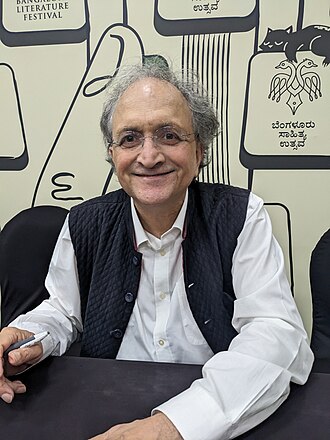
Contrary to what is sometimes claimed in the press, there are many fin — Ramachandra Guha
"Contrary to what is sometimes claimed in the press, there are many fine historians in India. From my own generation of scholars, I can strongly recommend — to student and lay reader alike — the work of Upinder Singh on ancient India, of Nayanjot Lahiri on the history of archaeology, of Vijaya Ramaswamy on the bhakti movement, of Sanjay Subrahmanyam on the early history of European expansion, of Chetan Singh on the decline of the Mughal State, of Sumit Guha on the social history of Western India, of Seema Alavi on the social history of medicine, of Niraja Gopal Jayal on the history of citizenship, of Tirthankar Roy on the economic consequences of colonialism, of Mahesh Rangarajan on the history of forests and wildlife, and of A. R. Venkatachalapathy on South Indian cultural history."

Ramachandra "Ram" Guha is an Indian historian, environmentalist, writer and public intellectual whose research interests include social, political, contemporary, environmental and cricket history. He is an important authority on the history of modern India. The American Historical Association (AHA) has conferred its Honorary Foreign Member prize for the year 2019 on Ramchandra Guha. He is the thir
View all quotes by Ramachandra GuhaMore by Ramachandra Guha
View all →"I was a student at the Delhi School at the very end of its Golden Age. The departments of economics and sociology were still world-class. Amartya Sen had left for England and M. N. Srinivas had retired to Bangalore; but Sukhamoy Chakravarty and André Béteille remained. There were also other brilliant scholars on the faculty—such as A. L. Nagar and Kaushik Basu in economics, and Veena Das and J. P. S. Uberoi in sociology. Both departments had active research programmes."
"[On “truly frightening” right-wing Hindu nationalism (by an Indian questioner), whether it will always be a force:] As a citizen, I detest right-wing Hindu nationalism, I will vote for any other party. As a historian, I would say; so long as you have Pakistan, you will have Hindu nationalism. If the political class is alert, it will weaken, but if the political class is weak, Hindu nationalism will be in the ascendant. The Jihadis bomb Bombay to provoke Hindu-Muslim violence. The Kashmiri movement started for rights, was taken over by Jihadis, and expelled Hindus from the Valley."
"Hind Swaraj is probably not the right place to start an exploration of Gandhi’s ideas. In the Cambridge edition, Anthony Parel warns the reader against the ‘vast sea of Gandhian anthologies’, but it is to these anthologies that those who wish to properly appreciate Gandhi must necessarily turn. The more thoughtful, the more informed, and the more essential Gandhi are to be found in his articles, editorials, and letters of the 1920s, 1930s, and 1940s, written as he came to more fully understand the people and practices of the country he was to lead to self-rule. The three selections from Gandhi’s writings that I would myself recommend are those made by Nirmal Kumar Bose, Raghavan Iyer (in its three-volume rather than single-volume rendition), and Gopalkrishna Gandhi. Having read these compilations, one can then turn to Hind Swaraj, perhaps to admire its precocious defence of non-violence and religious pluralism, while puzzling over its silence on caste and its demonization of the West."
"Where do Goldman and Eaton and Trautmann and Zelliot and Gold figure in the canon of South Asian Studies? Judging from the country where they work in, the United States of America, not very high. Were they to enter a seminar room at the Association of Asian Studies meetings there would not be the buzz that would certainly accompany the entrance of diasporic scholars ten times as glamorous but not half as accomplished."
"In the generation (or two generations) before mine, the leading Indian historians (judged in terms of scholarly books and papers written and read) included Irfan Habib, R. S. Sharma, Ranajit Guha, Romila Thapar, Bipan Chandra, Amalendu Guha, Sumit Sarkar, and Sabyasachi Bhattacharya, all of whom were influenced to a lesser or greater degree by Marxism; and Ashin Dasgupta, Dharma Kumar, Parthasarathy Gupta, Amales Tripathi, Rajat Kanta Rai, Mushirul Hasan, and Tapan Roychowdhury, all of whom were liberals. The leading political scientists included the liberals Rajni Kothari, Basheeruddin Ahmed and Ramashray Ray; the Marxists Javed Alam and Partha Chatterjee; and Ashis Nandy, an admirer of Tagore and Gandhi who like them stoutly resists being classified in conventional terms. The pre-eminent sociologists of that generation were M. N. Srinivas and André Béteille, both of whom would own the label ‘liberal’; and T. N. Madan, who while working on classically conservative themes such as family, kinship and religion would most likely see himself as a liberal too. Even the best-known or most influential economists of the 1960s and 1970 tended to be on the left of the spectrum, as the names of K. N. Raj, Amartya Sen, V. M. Dandekar, Amit Bhaduri, Krishna Bharadwaj, Pranab Bardhan, Prabhat and Utsa Patnaik, and Ashok Rudra (among others) signify."