"The laws of electricity and magnetism that underlie the existence of bulk matter dont care which bits... carry negative charge, and which... are positive. If we swapped all positives to negative, and all negatives to positive... resulting forces would be the same and the structures they built would... be unchanged. ...[T]o all outward appearances, nothing would appear different. Such a swapping of charges would turn what we know as matter into... antimatter. An anti-atom of would consist of a negative encircled by a positively charged . Paul Dirac... first predicted that such a mirror image of matter should exist."
[C]reation and annihilation concepts antedate quantum mechanics. The c — Antimatter
"[C]reation and annihilation concepts antedate quantum mechanics. The concept of annihilation of pairs of oppositely charged, elementary particles... dates from the turn of the twentieth century. It became important in astrophysics about 1924... The annihilating pairs were first positive and negative electrons, later protons and electrons, and finally, starting in 1931, electrons and anti-electrons. ...In Diracs "hole" theory of 1930... pair annihilation was neither novel nor central. Diracs object was to deal with a difficulty... that the theory allowed electrons to make transitions to . ...interpreting electrons in states of negative energy as unobservable, and empty negative-energy states, or "holes" as protons. As a by-product, when an electron jumped into a vacant negative-energy state, an electron and a proton disappeared together into radiation. Since pair annihilation was already an accepted concept, this... was admissible."

In modern physics, antimatter is defined as matter composed of the antiparticles of the corresponding particles in "ordinary" matter, and can be thought of as matter with reversed charges and parity, or going backward in time. Antimatter occurs in natural processes like cosmic ray collisions and some types of radioactive decay, but only a tiny fraction of these have successfully been bound togethe
View all quotes by AntimatterMore by Antimatter
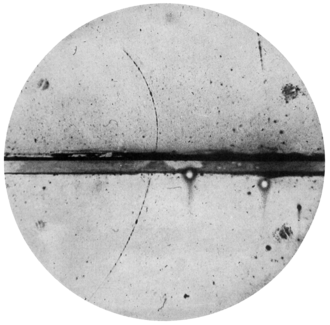
View all →"Dear Millikan, I have just received a letter from Rutherford which contains some of Blacketts work which may interest you and Anderson. It is that they have capitulated on the question of positive electrons and agree with Anderson that there are present in large numbers among the tertiary or quartinary (or whatever they are) ionizing particles seen in a Wilson photograph of the effects particles of positive charge and electronic mass. ...I take it that Blackett has collected so many photographs of such tracks as those earlier ones of Anderson that he can no longer resist this devastatingly interesting conclusion. Blacketts photos will come out in P.R.S. (Proceedings of the Royal Society) in March. I have a lecture to deliver."
"In the representative models... it has been found that successful leptogenesis is only possible in a very fine-tuned region of the parameter space. Specifically, one must select the f = u case, as well as certain combinations of Dirac and Majorana phases in UPMNS such that a lepton asymmetry can be generated via either resonant of flavoured N2-leptogenesis. Further, it has been shown that although the f = e case can yield a TeV scale RH neutrino, the probability of detecting it at the LHC or a next-generation collider such as the ILC is far too small."
"The interpretation of these tracks as due to protons, or other heavier nuclei, is ruled out on the basis of range and curvature. Protons or heavier nuclei of the observed curvatures could not have ranges as great as those observed. The specific-ionization is close to that for an electron of the same curvature, hence indicating a positively-charged particle comparable in mass and magnitude of charge with an electron."
"[I]t is quite fascinating that two seemingly unrelated problems—the tiny masses of light neutrino and the matter-antimatter asymmetry—may be explained by the mere introduction of heavy RH [right-hand] neutrinos to the SM. ...[T]he former may be explained by the Type I seesaw mechanism while thermal leptogenesis provides an attractive solution to the later. This... means that an intricate link between neutrino properties and the baryon asymmetry can be established. Consequently, it has been the purpose of this work to explore the implications of several different neutrino models in the leptogenesis context."
"We must regard it rather as an accident that the Earth (and presumably the whole solar system), contains a preponderance of negative electrons and positive positrons. It is quite possible that for some of the stars it is the other way about... built up mainly of s and negative protons. ...[T]here may be half the stars of each kind. The two... would both show exactly the same spectra... there would be no way of distinguishing them..."