Quote
"If what you have done yesterday still looks big to you, you havent done much today."
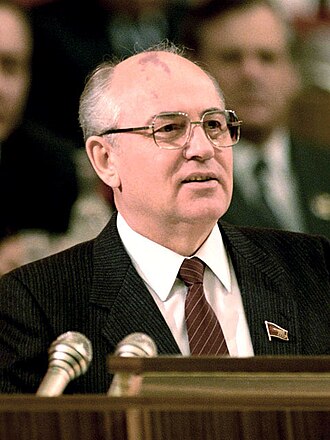 Mikhail Gorbachev
"Dangers await only those who do not react to life."
Mikhail Sergeyevich Gorbachev was a Soviet and Russian politician who was the last leader of the Soviet Union from 1985 until the country's dissolution in 1991. He served as General Secretary of the Communist Party from 1985, and additionally as head of state from 1988. Ideologically, he initially adhered to Marxism–Leninism, but moved towards social democracy by the early 1990s.
"If what you have done yesterday still looks big to you, you havent done much today."
Mikhail Gorbachev"Gorbachevs political views were more audacious. Unlike Deng Xiaoping, who, after the chaos of the Cultural Revolution, was obsessed with stability and ruled out democratic reforms, Gorbachev linked perestroika with a policy of glasnost (openness). Taking aim at the USSRs encrusted ruling party and bureaucracy, Gorbachev adopted a stillborn project of Andropovs to reduce their power by introducing new- even Western- ideas into the Soviet environment and engaging the Soviet population in modernizing the country. He went so far as to authorize the opening of the records of Soviet history, including its darkest moments, which ignited an explosion of criticism reaching back to Lenins rule. To be sure, Gorbachevs purpose was to preserve the communist system by revitalizing it from above, but by combining perestroika with glasnost the Soviet leader risked unleashing forces he was ultimately unable to control. Gorbachev was even more daring in his foreign policy because he believed that the relaxation of international tensions was indispensable to his political reforms at home. Convinced that the Soviet Unions greatest threat was nuclear war but that its huge military budget was unsupportable, he intended to achieve security by scaling down the global rivalry between Moscow and Washington and reviving détente. After assembling a group of like-minded liberal internationalists, among them the new foreign minister, Eduard Shevardnadze, and his foreign policy adviser, Anatoly Chernyaev, Gorbachev boldly embarked on a step-by-step program of reducing the USSRs isolation and reaching out to the other side, which included Western Europe, Japan, and China as well as the United States."
Mikhail Gorbachev"Few Soviet citizens lamented Gorbachëv’s going. His policies had ruined the economy and smashed the state into fragments. His critics showed him no mercy. This was ungenerous of them since without his introduction of glasnost and perestroika they could never have had the opportunity to calumniate him. Abroad, he was better respected. His disinclination to halt the decommunisation of eastern Europe by force was widely admired. His primary role in the ending of the Cold War was rightly esteemed. There had been many times when a different General Secretary would have called upon the armed forces and the KGB and reversed the reform programme. Yet the verdict on him has to take account of his inability to understand the nature of the Soviet order. He had genuinely believed that the USSR could be reformed and still remain communist. He had a passion for a democratic, humanitarian Lenin who had never existed in history."
Mikhail Gorbachev"President Gorbachev’s achievements were truly great and historic. Not only did he dissolve the Soviet Union more or less peacefully, but he also prevented a major civil war that could have escalated into a nuclear conflict. I sincerely hope that historians in the future will honor the major achievements and statesmanship of President Gorbachev and of the other leading Soviet politicians of that time."
Mikhail Gorbachev"Gorbachev faced a wary Western audience, which he had hoped to woo with vows to end the arms race. Before taking office, during his December 1984 visit to Britain, he had referred to Europe as "a common home... and not a theater of military operations" and had convinced Thatcher that he was a man with whom the West could "do business." But the Reagan administration, facing unexpectedly strong congressional opposition to its military budget, was unreceptive to the new leaders message and intensified its charges of the Soviets untrustworthiness and deplorable human rights record. Nonetheless, in a private message Reagan expressed interest in a summit meeting and assured Gorbachev of his hope to resume the search for "mutual understanding and peaceful development." The US and Soviet leaders met in Geneva in November 1985. At this first Superpower summit in six years, no treaty was signed, but the two-day meeting gave Reagan and Gorbachev an opportunity to evaluate each other and air their differences. Although they jointly declared that "a nuclear war can never be won and must never be fought" and agreed to accelerate work on nuclear arms control, Reagan defended SDI and Gorbachev refused to expand the agenda to include Afghanistan and human rights."
Mikhail Gorbachev"I consider it vitally important to preserve the democratic achievements which have been attained in the last few years. We have paid with all our history and tragic experience for these democratic achievements, and they are not to be abandoned, whatever the circumstances, and whatever the pretexts. Otherwise, all our hopes for the best will be buried."
Mikhail Gorbachev"In the life of the mass-order, the culture of the generality tends to conform to the demands of the average human being. Spirituality decays through being diffused among the masses when knowledge is impoverished in every possible way by rationalisation until it becomes accessible to the crude understanding of all."
"The first thing I remember about the world — and I pray that it may be the last — is that I was a stranger in it. This feeling, which everyone has in some degree, and which is, at once, the glory and desolation of homo sapiens, provides the only thread of consistency that I can detect in my life."
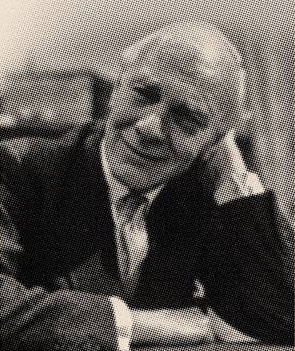 Malcolm Muggeridge
"Jewish custom, which traces descent solely from the mother, is more sensible and more discreet. Our own lawgivers cant accept the fact that there are many things in family life that are best kept shrouded in mystery."
"One makes mistakes; that is life. But it is never a mistake to have loved."
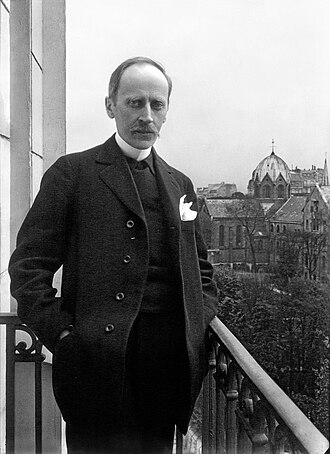 Romain Rolland
"If it fulfills our hopes, this center will be, at once, a symbol and a reflection and a hope. It will symbolize our belief that the world of creation and thought are at the core of all civilization. Only recently in the White House we helped commemorate the 400th anniversary of Shakespeare. The political conflicts and ambitions of his England are known to the scholar and to the specialist. But his plays will forever move men in every corner of the world. The leaders that he wrote about live far more vividly in his words than in the almost forgotten facts of their own rule. Our civilization, too, will largely survive in the works of our creation. There is a quality in art which speaks across the gulf dividing man from man and nation from nation, and century from century. That quality confirms the faith that our common hopes may be more enduring than our conflicting hostilities. Even now men of affairs are struggling to catch up with the insights of great art. The stakes may well be the survival of civilization. The personal preferences of men in government are not important--except to themselves. However, it is important to know that the opportunity we give to the arts is a measure of the quality of our civilization. It is important to be aware that artistic activity can enrich the life of our people, which really is the central object of Government. It is important that our material prosperity liberate and not confine the creative spirit."
"I did not go to join Kurtz there and then. I did not. I remained to dream the nightmare out to the end, and to show my loyalty to Kurtz once more. Destiny. My destiny! Droll thing life is — that mysterious arrangement of merciless logic for a futile purpose. The most you can hope from it is some knowledge of yourself — that comes too late — a crop of unextinguishable regrets. I have wrestled with death. It is the most unexciting contest you can imagine. It takes place in an impalpable grayness, with nothing underfoot, with nothing around, without spectators, without clamor, without glory, without the great desire of victory, without the great fear of defeat, in a sickly atmosphere of tepid skepticism, without much belief in your own right, and still less in that of your adversary. If such is the form of ultimate wisdom, then life is a greater riddle than some of us think it to be. I was within a hairs-breadth of the last opportunity for pronouncement, and I found with humiliation that probably I would have nothing to say. This is the reason why I affirm that Kurtz was a remarkable man. He had something to say. He said it. Since I had peeped over the edge myself, I understand better the meaning of his stare, that could not see the flame of the candle, but was wide enough to embrace the whole universe, piercing enough to penetrate all the hearts that beat in the darkness. He had summed up — he had judged. The horror! He was a remarkable man. After all, this was the expression of some sort of belief; it had candor, it had conviction, it had a vibrating note of revolt in its whisper, it had the appalling face of a glimpsed truth — the strange commingling of desire and hate."