Quote
"The past history of our globe must be explained by what can be seen to be happening now. No powers are to be employed that are not natural to the globe, no action to be admitted except those of which we know the principle."
J
James Hutton"Dr. Hutton... was highly pleased with appearances that set in so clear a light the different formations of the parts which compose the exterior crust of the earth... On us who saw these phenomena for the first time, the impression made will not easily be forgotten. ...The mind seemed to grow giddy by looking so far into the abbys of time; and while we listened with earnestness and admiration to the philosopher who was now unfolding to us the order and series of these wonderful events, we became sensible how much further reason may sometimes go than imagination can venture to follow."
James Hutton was a Scottish geologist, agriculturalist, chemical manufacturer, naturalist and physician. Often referred to as the "Father of Modern Geology," he played a key role in establishing geology as a modern science.
"The past history of our globe must be explained by what can be seen to be happening now. No powers are to be employed that are not natural to the globe, no action to be admitted except those of which we know the principle."
"Among the marks of disturbance in which the mineral kingdom abounds, those great breaches among rocks, which are filled with materials different from the rock on either side, are among the most conspicuous. These are the veins, and comprehend, not only the metallic veins, but also those of whinstone, of porphyry, and of granite, all of them substances more or less crystallized, and none of them containing the remains of organized bodies. ...The materials of all these veins Dr Hutton concludes to have been melted by subterraneous heat, and, while in fusion, injected among the fissures and openings of rocks already formed, but thus disturbed, and moved from their original place."
"The third general fact on which this theory is founded, is, that the stratified rocks, instead of being either horizontal, or nearly so, as they no doubt were originally, are now found possessing all degrees of elevation, and some of them even perpendicular to the horizon; to which we must add, that those strata which were once at the bottom of the sea are now raised up, many of them several thousand feet above its surface. ...This force, which has burst in pieces the solid pavement on which the ocean rests, and has raised up rocks from the bottom of the sea, into mountains... exceeds any which we see actually exerted, but seems to come nearer to the cause of the volcano or the earthquake than to any other, of which the effects are directly observed. The immense disturbance, therefore, of the strata, is in this theory ascribed to heat acting with an expansive power, and elevating those rocks which it had before consolidated."
"If an organised body is not in the situation and circumstances best adapted to its sustenance and propagation, then, in conceiving an indefinite variety among the individuals of that species, we must be assured, that, on the one hand, those which depart most from the best adapted constitution, will be most liable to perish, while, on the other hand, those organised bodies, which most approach to the best constitution for the present circumstances, will be best adapted to continue, in preserving themselves and multiplying the individuals of their race."
"In a letter to Sir John Hall, he says that he was become very fond of studying the surface of the earth, and was looking with anxious curiosity into every pit, or ditch, or bed of a river that fell in his way; "and that if he did not always avoid the fate of Thales, his misfortune was certainly not owing to the same cause." This letter is from Yarmouth; it has no date, but it is plain from circumstances that it must have been written in 1753."
"The first general fact which he has remarked is, that by far the greater part of the bodies which compose the exterior crust of our globe, bear the marks of being formed out of the materials of mineral or organized bodies, of more ancient date. The spoils or the wreck of an older world are every where visible in the present, and, though not found in every piece of rock, they are diffused so generally as to leave no doubt that the strata which now compose our continents are all formed out of strata more ancient than themselves."
"In the life of the mass-order, the culture of the generality tends to conform to the demands of the average human being. Spirituality decays through being diffused among the masses when knowledge is impoverished in every possible way by rationalisation until it becomes accessible to the crude understanding of all."
"I say this to you because we Spaniards are a forgetful people, because we are used to living for the moment, because we do not look back, because we do not know how to see the chain of heroes, because we do not contemplate the sum of sacrifices."
 Francisco Franco
"Sharon Tate was my best friend. Once, we were roommates. She introduced me to my husband. She was the godmother to my baby daughter who is named for her. In the six years time that I knew her, she never said an unkind word about anyone."
"Long time to see. (VS: Tapion)"
"Most mathematicians prove what they can, von Neumann proves what he wants." Once in a discussion about the rapid growth of mathematics in modern times, von Neumann was heard to remark that whereas thirty years ago a mathematician could grasp all of mathematics, that is impossible today. Someone asked him: "What percentage of all mathematics might a person aspire to understand today?" Von Neumann went into one of his five-second thinking trances, and said: "About 28 percent."
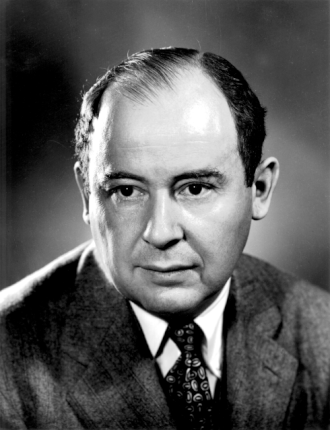 John von Neumann
"Children must be free to think in all directions irrespective of the peculiar ideas of parents who often seal their childrens minds with preconceived prejudices and false concepts of past generations. Unless we are very careful, very careful indeed, and very conscientious, there is still great danger that our children may turn out to be the same kind of people we are."