Quote
"I realize that in this undertaking I place myself in a certain opposition to views widely held concerning the mathematical infinite and to opinions frequently defended on the nature of numbers."
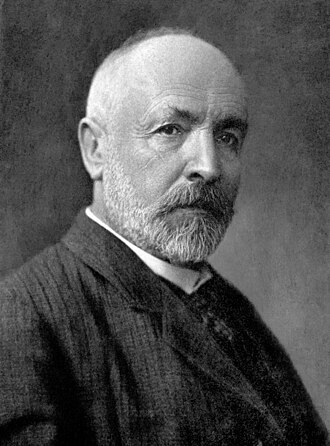 Georg Cantor
"Every transfinite consistent multiplicity, that is, every transfinite set, must have a definite aleph as its cardinal number."
Georg Ferdinand Ludwig Philipp Cantor was a mathematician who played a pivotal role in the creation of set theory, which has become a fundamental theory in mathematics. Cantor established the importance of one-to-one correspondence between the members of two sets, defined infinite and well-ordered sets, and proved that the real numbers are more numerous than the natural numbers. Cantor's method of
"I realize that in this undertaking I place myself in a certain opposition to views widely held concerning the mathematical infinite and to opinions frequently defended on the nature of numbers."
Georg Cantor"The old and oft-repeated proposition "Totum est majus sua parte" [the whole is larger than the part] may be applied without proof only in the case of entities that are based upon whole and part; then and only then is it an undeniable consequence of the concepts "totum" and "pars". Unfortunately, however, this "axiom" is used innumerably often without any basis and in neglect of the necessary distinction between "reality" and "quantity", on the one hand, and "number" and "set", on the other, precisely in the sense in which it is generally false."
Georg Cantor"That from the outset they expect or even impose all the properties of finite numbers upon the numbers in question, while on the other hand the infinite numbers, if they are to be considered in any form at all, must (in their contrast to the finite numbers) constitute an entirely new kind of number, whose nature is entirely dependent upon the nature of things and is an object of research, but not of our arbitrariness or prejudices."
Georg Cantor"[T]here exist no other sets than finite and denumerably infinite sets and continua... [I]n mathematics we can create only finite sequences, further by means of... and so on the order type ω, but only consisting of equal elements... but no other sets. Cantor and his disciples... think they have knowledge of all sorts of further sets; their fundamental principle... comes to about the same as the axiomaticians. ...[T]his principle is unjustified and... we assert that the several paradoxes of the Mengenlehre... have no right to exist... [I]t would have been the duty of Cantorians, immediately to reject a notion which gives rise to contradictions, because it is... not built... mathematically."
Georg Cantor"What I assert and believe to have demonstrated in this and earlier works is that following the finite there is a transfinite (which one could also call the supra-finite), that is an unbounded ascending ladder of definite modes, which by their nature are not finite but infinite, but which just like the finite can be determined by well-defined and distinguishable numbers."
Georg Cantor"I have never proceeded from any Genus supremum of the actual infinite. Quite the contrary, I have rigorously proved that there is absolutely no Genus supremum of the actual infinite. What surpasses all that is finite and transfinite is no Genus; it is the single, completely individual unity in which everything is included, which includes the Absolute, incomprehensible to the human understanding. This is the Actus Purissimus, which by many is called God. I am so in favor of the actual infinite that instead of admitting that Nature abhors it, as is commonly said, I hold that Nature makes frequent use of it everywhere, in order to show more effectively the perfections of its Author. Thus I believe that there is no part of matter which is not — I do not say divisible — but actually divisible; and consequently the least particle ought to be considered as a world full of an infinity of different creatures."
Georg Cantor