Quote
"Lhomme ne poursuit que des chimères."
P
Pierre-Simon Laplace"Given for one instant an intelligence which could comprehend all the forces by which nature is animated and the respective situation of the beings who compose it—an intelligence sufficiently vast to submit these data to analysis—it would embrace in the same formula the movements of the greatest bodies of the universe and those of the lightest atom; for it, nothing would be uncertain and the future, as the past, would be present to its eyes. The human mind offers, in the perfection which it has been able to give to astronomy, a feeble idea of this intelligence. Its discoveries in mechanics and geometry, added to that of universal gravity, have enabled it to comprehend in the same analytical expressions the past and future states of the system of the world."
Pierre-Simon, Marquis de Laplace was a French polymath, a scholar whose work has been instrumental in the fields of physics, astronomy, mathematics, engineering, statistics, and philosophy. He summarized and extended the work of his predecessors in his five-volume Mécanique céleste (1799–1825). This work translated the geometric study of classical mechanics to one based on calculus, opening up a b
"Lhomme ne poursuit que des chimères."
"La dernière chose que nous attendions de vous, Général, est une leçon de géométrie !"
"The most important questions of life... are indeed for the most part only problems of probability. Strictly speaking it may even be said that nearly all our knowledge is problematical; and in the small number of things which we are able to know with certainty, even in the mathematical sciences themselves, the principal means for ascertaining truth—induction and analogy—are based on probabilities."
"All these efforts in the search for truth tend to lead it [the human mind] back continually to the vast intelligence... but from which it will always remain infinitely removed. This tendency peculiar to the human race is that which renders it superior... and their progress in this respect distinguishes nations and ages and constitutes their true glory."
"Whenever I meet in La Place with the words "Thus it plainly appears," I am sure that hours, and perhaps days, of hard study will alone enable me to discover how it plainly appears."
"Said the great and magnanimous Laplace: It is India that gave us the ingenious method of expressing all numbers by ten symbols, each receiving a value of position as well as an absolute value; a profound and important idea which appears so simple to us now that we ignore its true merit. But its very simplicity, the great ease which it has lent to all computations, puts our arithmetic in the first rank of useful inventions; and we shall appreciate the grandeur of this achievement the more when we remember that it escaped the genius of Archimedes and Apollonius, two of the greatest men produced by antiquity."
"In the life of the mass-order, the culture of the generality tends to conform to the demands of the average human being. Spirituality decays through being diffused among the masses when knowledge is impoverished in every possible way by rationalisation until it becomes accessible to the crude understanding of all."
"I say this to you because we Spaniards are a forgetful people, because we are used to living for the moment, because we do not look back, because we do not know how to see the chain of heroes, because we do not contemplate the sum of sacrifices."
 Francisco Franco
"Sharon Tate was my best friend. Once, we were roommates. She introduced me to my husband. She was the godmother to my baby daughter who is named for her. In the six years time that I knew her, she never said an unkind word about anyone."
"Long time to see. (VS: Tapion)"
"Most mathematicians prove what they can, von Neumann proves what he wants." Once in a discussion about the rapid growth of mathematics in modern times, von Neumann was heard to remark that whereas thirty years ago a mathematician could grasp all of mathematics, that is impossible today. Someone asked him: "What percentage of all mathematics might a person aspire to understand today?" Von Neumann went into one of his five-second thinking trances, and said: "About 28 percent."
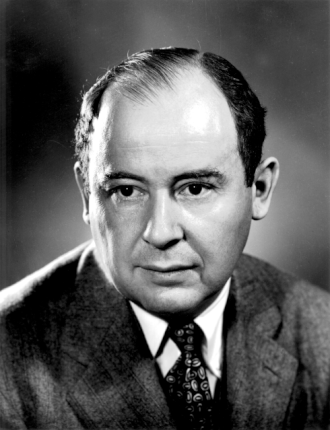 John von Neumann
"Children must be free to think in all directions irrespective of the peculiar ideas of parents who often seal their childrens minds with preconceived prejudices and false concepts of past generations. Unless we are very careful, very careful indeed, and very conscientious, there is still great danger that our children may turn out to be the same kind of people we are."