SHAWORDS

He is a truly complex fellow, not unlike the Michelangelos and da Vinc — Fred Astaire

HomeFred AstaireQuote
"He is a truly complex fellow, not unlike the Michelangelos and da Vincis of the Renaissance period. Hes a supreme artist but he is constantly filled with doubts and self-anger about his work--and that is what makes him so good. He is a perfectionist who is never sure he is attaining perfection."
He is a truly complex fellow, not unlike the Michelangelos and da Vincis of the Renaissance period. Hes a supreme artist
Fred Astaire
Fred Astaire
Fred Astaire
author44 quotes

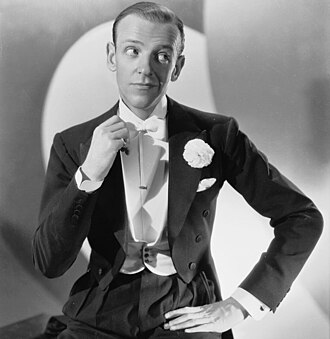
Fred Astaire was an American dancer, actor, singer, musician, choreographer, and presenter, whose career in stage, film, and television spanned 76 years. He is widely regarded as the "greatest popular-music dancer of all time". He received an Honorary Academy Award, a BAFTA Award, three Emmy Awards, two Golden Globe Awards, and a Grammy Award.

About Fred Astaire

Fred Astaire was an American dancer, actor, singer, musician, choreographer, and presenter, whose career in stage, film, and television spanned 76 years. He is widely regarded as the "greatest popular-music dancer of all time". He received an Honorary Academy Award, a BAFTA Award, three Emmy Awards, two Golden Globe Awards, and a Grammy Award.

View all quotes by Fred Astaire

More by Fred Astaire

View all →
Quote
"We were only together for a part of my career, and for every film we did, I did another three on my own. The studio was working me too hard. Fred would rush off for a holiday and call me and say: "Hey, ready to do another?" And I didnt have the sense to say that I was too tired. Those times were murder for me. Oh, I adored Mr. A but all the hard work...the 5 a.m. calls, the months of non-stop dancing, singing and acting. We just worked it out and had a lot of fun and got very exhausted. And Mr A was quite divine."
Fred AstaireFred Astaire
Quote
"It was on tiny wheels with a mount for the camera that put the lens about two feet above the ground. On it rode the camera operator and the assistant who changed the focus and thats all. Fred always wanted to keep the camera in as tight as possible, and they used to shoot with a 40 millimetre lens, which doesnt give you too much leeway. So every time Fred and Ginger moved toward us, the camera had to go back, and every time they went back, the camera went in. The head grip who was in charge of pushing this thing was a joy to watch. He would maintain a consistent distance, and when they were in the midst of a hectic dance thats quite a stunt."
Fred AstaireFred Astaire
Quote
"I remember when I was doing a film with Fred Astaire, it was nothing for him to work three or four days on two bars of music. One evening in the dark grey hours of dusk, I was walking across the deserted MGM lot when a small, weary figure with a towel around his neck suddenly appeared out of the giant cube sound stages. It was Fred. He came over to me, threw a heavy arm around my shoulder and said: "Oh Alan, why doesnt someone tell me I cannot dance?" The tormented illogic of his question made any answer insipid, and all I could do was walk with him in silence."
Fred AstaireFred Astaire
Quote
"A very distinguished colleague began his criticism of this show by asking what is Mr Astaires secret. May I suggest that the solution hangs on a little word of three letters? Mr Astaires secret is that of the late Rudolph Valentino and of Mr Maurice Chevalier — sex, but sex so bejewelled and be-pixied that the weaker vessels who fall for it can pretend that it isnt sex at all but a sublimated projection of the Little Fellow with the Knuckles in His Eyes. Youd have thought by the look of the first night foyer that it was Mothering Thursday, since every woman in the place was urgent to take to her bosom this waif with the sad eyes and the twinkling feet."
Fred AstaireFred Astaire

More on Self

View all →
Quote
"At one point a heated discussion arose over the possible interpretation of Lolita as a grandiose metaphor of the classic Europeans hopeless love for young, seductive, barbaric America. In his afterword to the novel Nabokov himself mentions this as the naive theory of one of the publishers who turned the book down. And although there cant be the slightest doubt that Nabokov did not mean to limit Lolita to that interpretation, there is no reason to exclude it as one of the novels many dimensions. The point, I felt, became obvious when one drew the line between Lolita as a delightfully frivolous story on the verge of pornography and Lolita as a literary masterpiece, the only convincing love story of our century."
LolitaLolita
Quote
"I did not go to join Kurtz there and then. I did not. I remained to dream the nightmare out to the end, and to show my loyalty to Kurtz once more. Destiny. My destiny! Droll thing life is — that mysterious arrangement of merciless logic for a futile purpose. The most you can hope from it is some knowledge of yourself — that comes too late — a crop of unextinguishable regrets. I have wrestled with death. It is the most unexciting contest you can imagine. It takes place in an impalpable grayness, with nothing underfoot, with nothing around, without spectators, without clamor, without glory, without the great desire of victory, without the great fear of defeat, in a sickly atmosphere of tepid skepticism, without much belief in your own right, and still less in that of your adversary. If such is the form of ultimate wisdom, then life is a greater riddle than some of us think it to be. I was within a hairs-breadth of the last opportunity for pronouncement, and I found with humiliation that probably I would have nothing to say. This is the reason why I affirm that Kurtz was a remarkable man. He had something to say. He said it. Since I had peeped over the edge myself, I understand better the meaning of his stare, that could not see the flame of the candle, but was wide enough to embrace the whole universe, piercing enough to penetrate all the hearts that beat in the darkness. He had summed up — he had judged. The horror! He was a remarkable man. After all, this was the expression of some sort of belief; it had candor, it had conviction, it had a vibrating note of revolt in its whisper, it had the appalling face of a glimpsed truth — the strange commingling of desire and hate."
H
Heart of Darkness
Quote
"He was obeyed, yet he inspired neither love nor fear, nor even respect. He inspired uneasiness. That was it! Uneasiness. Not a definite mistrust — just uneasiness — nothing more. You have no idea how effective such a... a... faculty can be. He had no genius for organizing, for initiative, or for order even. That was evident in such things as the deplorable state of the station. He had no learning, and no intelligence. His position had come to him — why? Perhaps because he was never ill . . . He had served three terms of three years out there . . . Because triumphant health in the general rout of constitutions is a kind of power in itself."
H
Heart of Darkness