SHAWORDS

How is the mind which functions on knowledge — how is the brain which — Jiddu Krishnamurti

"How is the mind which functions on knowledge — how is the brain which is recording all the time — to end, to see the importance of recording and not let it move in any other direction? Very simply: you insult me, you hurt me, by word, gesture, by an actual act; that leaves a mark on the brain which is memory. That memory is knowledge, that knowledge is going to interfere in my meeting you next time — obviously."
J
Jiddu Krishnamurti
Jiddu Krishnamurti
author78 quotes

Jiddu Krishnamurti was an Indian spiritual figure, speaker, and writer. Adopted by members of the Theosophical Society as a child, Krishnamurti was raised to fill the mantle of the prophesied World Teacher, a role tasked with aiding humankind's spiritual evolution. In 1922, he began to suffer from painful, seizure-like mystical episodes that would produce a lasting change in his perception of real

More by Jiddu Krishnamurti

View all →
Quote
"Now, can one die every day to everything that one knows — except, of course, the technological knowledge, the direction where your home is, and so on; that is, to end, psychologically, every day, so that the mind remains fresh, young and innocent? That is death. And to come upon that there must be no shadow of fear. To give up without argument, without any resistance. That is dying. Have you ever tried it? To give up without a murmur, without restraint, without resistance, the thing that gives you most pleasure (the things that are painful, of course, one wants to give up in any case). Actually to let go. Try it. Then, if you do it, you will see that the mind becomes extraordinarily alert, alive and sensitive, free and unburdened. Old age then takes on quite a different meaning, not something to be dreaded."
J
Jiddu Krishnamurti
Quote
"When death comes, it does not ask your permission; it comes and takes you; it destroys you on the spot. In the same way, can you totally drop hate, envy, pride of possession, attachment to beliefs, to opinions, to ideas, to a particular way of thinking? Can you drop all that in an instant? There is no “how to drop it”, because that is only another form of continuity. To drop opinion, belief, attachment, greed, or envy is to die — to die every day, every moment. If there is the coming to an end of all ambition from moment to moment, then you will know the extraordinary state of being nothing, of coming to the abyss of an eternal movement, as it were, and dropping over the edge — which is death. I want to know all about death, because death may be reality; it may be what we call God — that most extraordinary something that lives and moves and yet has no beginning and no end."
J
Jiddu Krishnamurti
Quote
"Desire, which has been the driving force in man, has created a great many pleasant and useful things; desire also, in mans relationships, has created a great many problems and turmoil and misery — the desire for pleasure. The monks and the sannyasis of the world have tried to go beyond it, have forced themselves to worship an ideal, an image, a symbol. But desire is always there like a flame, burning. And to find out, to probe into the nature of desire, the complexity of desire, its activities, its demands, its fulfilments — ever more and more desire for power, position, prestige, status, the desire for the unnameable, that which is beyond all our daily life — has made man do all kinds of ugly and brutal things. Desire is the outcome of sensation the outcome with all the images that thought has built. And this desire not only breeds discontent but a sense of hopelessness. Never suppress it, never discipline it but probe into the nature of it — what is the origin, the purpose, the intricacies of it? To delve deep into it is not another desire, for it has no motive; it is like understanding the beauty of a flower, to sit down beside it and look at it. And as you look it begins to reveal itself as it actually is — the extraordinarily delicate colour, the perfume, the petals, the stem and the earth out of which it has grown. So look at this desire and its nature without thought which is always shaping sensations, pleasure and pain, reward and punishment. Then one understands, not verbally, nor intellectually, the whole causation of desire, the root of desire. The very perception of it, the subtle perception of it, that in itself is intelligence. And that intelligence will always act sanely and rationally in dealing with desire."
J
Jiddu Krishnamurti

More on Time

View all →
Quote
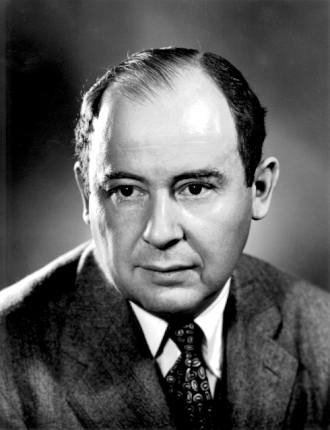
"Most mathematicians prove what they can, von Neumann proves what he wants." Once in a discussion about the rapid growth of mathematics in modern times, von Neumann was heard to remark that whereas thirty years ago a mathematician could grasp all of mathematics, that is impossible today. Someone asked him: "What percentage of all mathematics might a person aspire to understand today?" Von Neumann went into one of his five-second thinking trances, and said: "About 28 percent."
John von NeumannJohn von Neumann