Quote
"The scapegoat upon whom the sins of the people are periodically laid, may also be a human being."
 James Frazer
"If in the present work I have dwelt at some length on the worship of trees, it is not, I trust, because I exaggerate its importance in the history of religion, still less because I would deduce from it a whole system of mythology; it is simply because I could not ignore the subject in attempting to explain the significance of a priest who bore the title of King Of the Wood, and one of whose titles to office was the plucking of a bough — the Golden Bough — from a tree in the sacred grove."
Sir James George Frazer was a Scottish social anthropologist and folklorist influential in the early stages of the modern studies of mythology and comparative religion.
Sir James George Frazer was a Scottish social anthropologist and folklorist influential in the early stages of the modern studies of mythology and comparative religion.
View all quotes by James Frazer"The scapegoat upon whom the sins of the people are periodically laid, may also be a human being."
James Frazer"If we analyze the principles of thought on which magic is based, they will probably be found to resolve themselves into two: first, that like produces like, or that an effect resembles its cause; and, second, that things which have once been in contact with each other continue to act on each other at a distance after the physical contact has been severed. The former principle may be called the Law of Similarity, the latter the Law of Contact or Contagion. From the first of these principles, namely the Law of Similarity, the magician infers that he can produce any effect he desires merely by imitating it: from the second he infers that whatever he does to a material object will affect equally the person with whom the object was once in contact, whether it formed part of his body or not."
James Frazer"In primitive society, where uniformity of occupation is the rule, and the distribution of the community into various classes of workers has hardly begun, every man is more or less his own magician; he practices charms and incantations for his own good and the injury of his enemies."
James Frazer"If the test of truth lay in a show of hands or a counting of heads, the system of magic might appeal, with far more reason than the Catholic Church, to the proud motto, Quod semper, quod ubique, quod ab omnibus [always, everywhere, and by all], as the sure and certain credential of its own infallibility."
James Frazer"In primitive society the rules of ceremonial purity observed by divine kings, chiefs, and priests agree in many respects with the rules observed by homicides, mourners, women in childbed, girls at puberty, hunters and fishermen, and so on. To us these various classes of persons appear to differ totally in character and condition; some of them we should call holy, others we might pronounce unclean and polluted. But the savage makes no such moral distinction between them; the conceptions of holiness and pollution are not yet differentiated in his mind. To him the common feature of all these persons is that they are dangerous and in danger, and the danger in which they stand and to which they expose others is what we should call spiritual or ghostly, and therefore imaginary. The danger, however, is not less real because it is imaginary; imagination acts upon man as really does gravitation, and may kill him as certainly as a dose of prussic acid."
James Frazer"For myth changes while custom remains constant; men continue to do what their did before them, though the reasons on which their fathers acted have been long forgotten.The history of religion is a long attempt to reconcile old custom with new reason, to find a sound theory for an absurd practice."
James Frazer"In the life of the mass-order, the culture of the generality tends to conform to the demands of the average human being. Spirituality decays through being diffused among the masses when knowledge is impoverished in every possible way by rationalisation until it becomes accessible to the crude understanding of all."
"I say this to you because we Spaniards are a forgetful people, because we are used to living for the moment, because we do not look back, because we do not know how to see the chain of heroes, because we do not contemplate the sum of sacrifices."
 Francisco Franco
"Sharon Tate was my best friend. Once, we were roommates. She introduced me to my husband. She was the godmother to my baby daughter who is named for her. In the six years time that I knew her, she never said an unkind word about anyone."
"Long time to see. (VS: Tapion)"
"Most mathematicians prove what they can, von Neumann proves what he wants." Once in a discussion about the rapid growth of mathematics in modern times, von Neumann was heard to remark that whereas thirty years ago a mathematician could grasp all of mathematics, that is impossible today. Someone asked him: "What percentage of all mathematics might a person aspire to understand today?" Von Neumann went into one of his five-second thinking trances, and said: "About 28 percent."
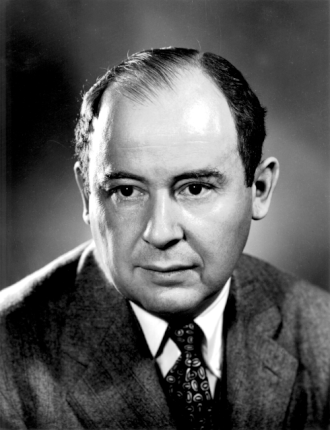 John von Neumann
"Children must be free to think in all directions irrespective of the peculiar ideas of parents who often seal their childrens minds with preconceived prejudices and false concepts of past generations. Unless we are very careful, very careful indeed, and very conscientious, there is still great danger that our children may turn out to be the same kind of people we are."