Quote
"The fault, dear Brutus, lies not in the stars but in our lousy genes. Or in the failure of one’s conquest of one’s self. The fault, dear Brutus, is in our fear of knowing ourselves."
P
Philip José Farmer"If the Creator has a plan for us, why doesn’t He tell us what it is? Are we so stupid that we can’t understand it? He should tell it to us directly! The books that the prophets, the revelators, and the revisionists wrote, claiming to have authority from God Himself, to have taken His dictations, these so-called revelations are false! They make no sense! Besides, they contradict each other! Does God make contradictory statements?"
Philip José Farmer was an American author known for his science fiction and fantasy novels and short stories.
"The fault, dear Brutus, lies not in the stars but in our lousy genes. Or in the failure of one’s conquest of one’s self. The fault, dear Brutus, is in our fear of knowing ourselves."
"Where this area had been beautiful with its many trees and bright grass and the colored blooms of the vines that covered the trees, it was now like a battlefield. It had been necessary to create ugliness to build a beautiful boat."
"He was stiff and sometimes a little strange, which was what you’d expect from an engineer, but he had a moral backbone as inflexible as a fossilized dinosaur’s."
"But we may not be able to climb high enough. Look at those mountains. They go straight up, smooth as a politician denying he ever made a campaign promise."
"Styles was an old Mississippi pilot, a handsome youth, no liar, though given to inflating facts."
"He seemed to get along with just about everybody. Which, in my book, makes him suspect."
"In a huge embarrassment to the Saudi authorities, the Islamic State adopted official Saudi textbooks for its schools until the extremist group could publish its own books in 2015. Out of 12 works by Muslim scholars republished by the Islamic State, seven are by Muhammad ibn Abd al-Wahhab, the 18th-century founder of the Saudi school of Islam."
 Saudi Arabia
"Popular culture entered my life as Shirley Temple, who was exactly my age and wrote a letter in the newspapers telling how her mother fixed spinach for her, with lots of butter. There were paper-doll books of her and of the Dionne Quintuplets-five identical girls born to a French-Canadian family and of the famous dollhouse of the actress Colleen Moore, which contained every luxury conceivable in perfect miniature, including a tiny phonograph that played Gershwins Rhapsody in Blue. I was impressed by Shirley Temple as a little girl my age who had power: she could write a piece for the newspapers and have it printed in her own handwriting. I must have seen her dancing with Bill "Bojangles" Robinson in The Littlest Rebel, but I remember her less as a movie star than as a presence, like President Roosevelt, or Lindbergh, whose baby had been stolen; but she was a little girl whose face was everywhere on glass mugs and in coloring books as well as in the papers."
 Shirley Temple
"Amy Kofman: Have you read all the books in here? Derrida: No, only four of them. But I read those very, very carefully."
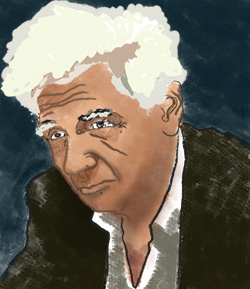 Jacques Derrida
"Lord!" he said, "when you sell a man a book you dont sell him just twelve ounces of paper and ink and glue — you sell him a whole new life. Love and friendship and humour and ships at sea by night — theres all heaven and earth in a book, a real book I mean. Jiminy! If I were the baker or the butcher or the broom huckster, people would run to the gate when I came by — just waiting for my stuff. And here I go loaded with everlasting salvation — yes, maam, salvation for their little, stunted minds — and its hard to make em see it. Thats what makes it worth while — Im doing something that nobody else from Nazareth, Maine, to Walla Walla, Washington, has ever thought of. Its a new field, but by the bones of Whitman, its worth while. Thats what this country needs — more books!"
"Printers ink has been running a race against gunpowder these many, many years. Ink is handicapped, in a way, because you can blow up a man with gunpowder in half a second, while it may take twenty years to blow him up with a book. But the gunpowder destroys itself along with its victim, while a book can keep on exploding for centuries."
"By the same proportion that a penny saved is a penny gained, the preserver of books is a Mate for the Compiler of them."