Quote
"Among others there are three methods for shaping shells: the freely shaped hill, the membrane under pressure and the hanging cloth reversed."
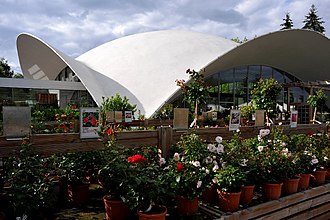 Heinz Isler
"Isler’s methods were completely based on physical modeling and experiments. In fact, he rarely used general mathematical theories when designing his shells."
Heinz Isler was a Swiss structural engineer. He is famous for his thin concrete shells.
"Among others there are three methods for shaping shells: the freely shaped hill, the membrane under pressure and the hanging cloth reversed."
Heinz Isler"[T]heoretical considerations and derivations … are always based on severe simplifications of the assumptions."
Heinz Isler"...I do not say any form which you construct this way is a good form, or must lead to a good solution; but there are forms which can lead to good solutions, and of course that is only the first link in a whole chain of investigations, and the other links in the investigation, model tests, measuring of the first structure, or a model test in scale 1:1 as we have it out here, these are of primary importance. So the engineer[‘s] problem is remaining all the same, but it is the first link, here, the shaping which has been lacking up to now, and this method can lead to a very nice solution."
Heinz Isler"The majority of Islers shells are specifically designed to remain in compression under all load conditions, but in the case of the hyperbolic paraboloid [Heilig Geist Kirche (Holy Spirit Church), ] both tension and compression stresses normally occur. To overcome the adverse effects of the tension stresses Isler applied a pre-stress through the shell surface by post-tensioning using eight cables between the wall tops... This he simulated in the workshop model... as usual for Islers experimental technique, the roof loads were applied by means of small wooden discs distributed evenly over the surface to simulate uniformly distributed load. In turn these were connected to a hanging network of timber spreader bars and strings in such a way that the distributed load could be applied with a single weight or hydraulic jack. The pre-stressing force was applied by small hydraulic jacks. This arrangement allowed vertical, horizontal and pre-stressing loads to be applied in appropriate combinations, simulating the shell self-weight, full snow load, partial snow, etc. Uplift loads induced by the wind were assessed by appropriate factoring and reversing the stresses (derived from electrical strain gauges attached to the model surface) resulting from downward loads."
Heinz Isler"[Architects and engineers] must be willing to subordinate themselves to the emerging logic of the shell’s form as it evolves through experimentation."
Heinz Isler"Heinz Isler’s innovative methods for determining the shape of reinforced concrete shells first became widely known through his presentation of a paper entitled ‘New Shapes for Shells’... At that time reinforced concrete shells were a very popular form of construction worldwide. However, their forms were almost entirely those which could be described easily by geometrical and mathematical formulae e.g. barrel vaults, spherical domes, conoids, and constructed using relatively simple formwork as in the case of the straight boards used for hyperbolic paraboloid surfaces. ...[A] rounded mound of soil encircled by a trench and captioned “Form for a shell in concrete”; a stepped swimming pool of organic shape dug into the ground, labelled “Plastic shell as swimming pool”; and some rectangular ‘bubble’ shell roofs... illustrate the two of the three form-finding methods..."
Heinz Isler