"The Revolution had been made in the name of peace, bread and Soviet power. It turned out to mean civil war, starvation and the dictatorship of the Bolshevik Partys Central Committee and its increasingly potent subcommittee, the Politburo. Workers who had supported the Bolsheviks in the expectation of a decentralized soviet regime found themselves being gunned down if they had the temerity to strike at newly nationalized factories. With inflation rampant, their wages in real terms were just a fraction of what they had been before the war. War Communism reduced hungry city dwellers to desperate bartering expeditions to the country and to burning everything from their neighbours doors to their own books for heat. As the conscription system grew more effective, more and more young men found themselves drafted into the Red Army, which grew in number from less than a million in January 1919 to five million by October 1920, though desertion rates remained high, especially around harvest time. When the previously pro-Bolshevik sailors of Kronstadt mutinied in February 1921 , they denounced the regime for crushing freedom of speech, press and assembly and filling prisons and concentration camps with their political rivals."
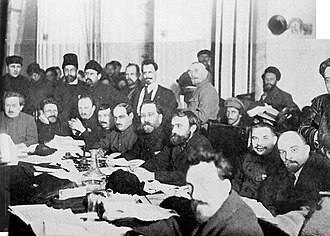
It is a curious fact that the Russian Bolsheviks, in carrying by compu — Bolsheviks
"It is a curious fact that the Russian Bolsheviks, in carrying by compulsion mass conceptions to their utmost extreme, seem to have lost not only the guidance of great personalities, but even the economic fertility of the process itself. The Communist theme aims at universal standardization. The individual becomes a function: the community is alone of interest: mass thoughts dictated and propagated by the rulers are the only thoughts deemed respectable. No one is to think of himself as an immortal spirit, clothed in the flesh, but sovereign, unique, indestructible. No one is to think of himself even as that harmonious integrity of mind, soul and body, which, take it as you will, may claim to be the Lord of Creation. Subhuman goals and ideals are set before these Asiastic millions. The Beehive? No, for there must be no queen and no honey, or at least no honey for others. In Soviet Russia we have a society which seeks to model itself upon the Ant. There is not one single social or economic principle or concept in the philosophy of the Russian Bolshevik which has not been realized, carried into action, and enshrined in immutable laws a million years ago by the White Ant."

The Bolsheviks, led by Vladimir Lenin, were a radical faction of the Marxist Russian Social Democratic Labour Party (RSDLP) which split with the Mensheviks at the Second Party Congress in 1903. The Bolshevik party, formally established in 1912, seized power in Russia in the October Revolution of 1917 and was later renamed the Russian Communist Party, All-Union Communist Party, and ultimately the C
View all quotes by BolsheviksMore by Bolsheviks
View all →"The Bolsheviks shared with the elites within the Russian empire a conviction that their country would eventually become the center of a new world civilization that would be both modern and just. Lenin believed that having been the first country that experienced a socialist revolution, Russia could do much to help revolutionaries in other countries – it could function as a base area and rear guard for the revolutions in the more advanced countries of Europe, which, Lenin believed, would follow soon. But in spite of the country’s social and technological backwardness, Lenin believed that the organization of its proletariat through the Communist Party had given Russia the edge – and that it could teach the lessons of the October Revolution to other proletarian parties. ‘‘To wait until the working classes carry out a revolution on an international scale means that everyone will remain suspended in mid-air,’’ Lenin said in May 1918. The very fact that the main imperialist powers had intervened against the new Soviet state in the civil war that followed the October Revolution proved to the Bolsheviks how crucial their section of the front against imperialism was."
"The Communist challenge to the capitalist world system also started with the Great War. The war split Social Democratic parties everywhere into prowar and antiwar camps. Some Social Democrats supported the war efforts out of a sense of obligation to the nation. But in Germany, France, Italy, and Russia, minority socialists, including the Russian Bolsheviks, condemned the fighting as a conflict between different groups of capitalists. Karl Liebknecht, the only socialist who voted against the war in the German parliament, bravely argued that “this war, which none of the peoples involved desired, was not started for the benefit of the German or of any other people. It is an imperialist war, a war for capitalist domination of world markets and for the political domination of important colonies in the interest of industrial and financial capital.” Revolutionaries such as Liebknecht and Lenin contended that soldiers, workers, and peasants had more in common with their brothers on the other side than with their superior officers and the capitalists behind the lines. The war was between robbers and thieves, for which ordinary people had to suffer. Capitalism itself produced war and would produce more wars if it was not abolished. The answer, the ultra-Left proclaimed, was a transnational form of revolution, in which soldiers turned their weapons on their own officers and embraced their comrades across the trenches."
"This position by the Leninists of the necessity for a dictatorship to protect the revolution was not proven in the Civil War which followed the Russian revolution; in fact without support of the Anarchists and other left-wing forces, along with the Russian people, the Bolshevik government would have been defeated. And then true to any dictatorship, it turned around and wiped out the Russian and Ukrainian Anarchist movements, along with their left-wing opponents like the and Social revolutionaries. Even ideological opponents in the Bolshevik party were imprisoned and put to death. Lenin and Trotsky killed millions of Russian citizens right after the Civil War, when they were consolidating State power, which preceded Stalin’s bloody rule. The lesson is that we should not be tricked into surrendering the grassroots people’s power to dictators who pose as our friends or leaders."
"The other epidemic was Bolshevism, which for a time seemed almost as contagious and ultimately proved as lethal as the influenza. With the end of the war, Soviet-style governments were proclaimed in Budapest, Munich and Hamburg. The red flag was even raised above Glasgow City Chambers. Lenin dreamed of a Union of Soviet Republics of Europe and Asia. Trotsky declared that the road to Paris and London lies via the towns of Afghanistan, the Punjab and Bengal. Even distant Buenos Aires was rocked by strikes and street fighting."
"Russian bolshevism, replacing eastern Christendom by the grim religiosity of Marx, produced a caricature of the evangelical counsels with many a diabolical aspect. There is a good deal of "communism" in monasteries and convents, yet this is based upon a voluntary renunciation of perfect human rights. On account of our free will we can make supreme sacrifices which ennobles our very existence. Bolshevism on the other hand forces us brutally into a parody of monastic life amidst fellow monks and fellow nuns who hate their habit and sigh under the ferocious tyranny of their pseudo-abbot. This evil distortion of an otherwise Christian ideal is more satanic than wanton, a thoroughly pagan and diabolic opposition to Christian existence. This explains also the reason why the Vatican has found stronger words against "altruistic" bolshevism than against egoistic capitalism."