Quote
"Poverty is the mother of crime."
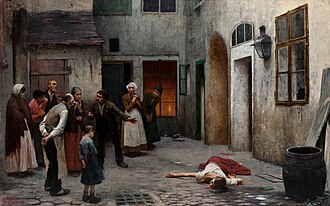 Crime
Crime"It is unlikely that each and every criminal behavior committed will ever be retrospectively scrutinized in the same manner as accidental deaths (whether in the line of duty, in the medical field, or from accidents resulting from product malfunction or negligence in other arenas). However, understanding why crime occurs requires focus on both aggregate-level factors (e.g., factors statistically associated with criminal behavior across large groups of offenders) and individual-level factors (the unique influences and chain of events in an individual’s life contributing to the criminal behavior). Theory and research directed toward identifying correlates of crime at the aggregate level as well as detailed analysis of individual-level offenses are necessary to explain why crime occurs. For example, research shows that gender, age, and social class are highly correlated with criminal behavior, with young males of lower socioeconomic status being more likely to commit crime. However, knowing that a person is young, male, and poor yells us very little about why a particular person decides to engage in an individual criminal behavior or a lifestyle of crime, nor can these factors be used to predict or clearly explain the dynamics of individual-level criminal acts."
"Poverty is the mother of crime."
Crime"My servant ... was numbered with the transgressors."
Crime"There is considerable overlap between sociological theories of crime and theories of (noncriminal) deviance. Sociological theories that explain criminal behavior also explain deviant behavior such as college student cheating, eating disorders, bad habits and unusual sexual behaviors. Sociological theories can be broken down into three general types: “structural”, “cultural” and “interactionist”. Structural theories see criminal behavior as a product of social structure, cultural theories contend that criminal behavior is rooted in and shaped by delinquent subcultures, and interactionist theories look at the interactional forces that explain why some people commit crime while others from the same background and social circumstances do not."
Crime"Another prominent superego pathology theory is Kernberg’s theory of “borderline personality organization (BPO)”. BPO theory is particularly helpful in terms of understanding how internal conditions across the continuum of personality produce a tendency toward criminal behavior. According to Kernnberg (1966, 1967, 1984, 1985a, 1985b, 1992), personality is organized by capacity for reality testing and unconscious defensive process. Psychotic personality organization is characterized by absence of reality testing and the use of primitive defenses, borderline personality organization by capacity for reality testing and use of primitive defenses, and neurotic personality organization by capacity for reality testing and use of higher-level defenses (Figure 2.1). Kernberg’s “primitive defenses” center around the lower level mechanism of “splitting”, the related mechanisms of “primitive idealization, projective identification, denial, omnipotence,” and “devaluation”. Splitting is a genotypic defensive operation that is expressed through the phenotypic defensive process of dissociation. This defensive operation is pathognomic of general borderline ego functioning, particularly in the psychopath (Meloy, 1988). Kernberg (1976) views splitting as alternating ego states, each consisting of completely separate complex psychic manifestations, a fundamental feature of the borderline ego functioning experienced by the narcissistic, histrionic, borderline, and psychopathic personalities. Splitting is a defensive process exemplified by lack of personality integration, and the coexistence of distinct cohesive personality attitudes with conflicting aims, goals, and moral and aesthetic values (Kohut, 1971). Put simply, splitting is the view of oneself and others as all good or all bad with an inability to reconcile the two identities."
Crime"(2) If crime is depicted it shall be as a sordid and unpleasant activity."
Crime"If England treats her criminals the way she has treated me, she doesnt deserve to have any."
Crime