Quote
"Man is the only one that knows nothing, that can learn nothing without being taught. He can neither speak nor walk nor eat, and in short he can do nothing at the prompting of nature only, but weep."
P
Pliny the Elder"It was a custom with Apelles, to which he most tenaciously adhered, never to let any day pass, however busy he might be, without exercising himself by tracing some outline or other,—a practice which has now passed into a proverb. It was also a practice with him, when he had completed a work, to exhibit it to the view of the passers-by in his studio, while he himself, concealed behind the picture, would listen to the criticisms…. Under these circumstances, they say that he was censured by a shoemaker for having represented the shoes with one latchet too few. The next day, the shoemaker, quite proud at seeing the former error corrected, thanks to his advice, began to criticise the leg; upon which Apelles, full of indignation, popped his head out and reminded him that a shoemaker should give no opinion beyond the shoes, —a piece of advice which has equally passed into a proverbial saying."
Gaius Plinius Secundus, known in English as Pliny the Elder, was a Roman author, naturalist, scientist, naval and army commander of the early Roman Empire, procurator, and friend of the emperor Vespasian. Pliny wrote the encyclopedic Naturalis Historia, a thirty-seven-volume work covering a vast array of topics on human knowledge and the natural world, which became an editorial model for encyclope
"Man is the only one that knows nothing, that can learn nothing without being taught. He can neither speak nor walk nor eat, and in short he can do nothing at the prompting of nature only, but weep."
"With man, most of his misfortunes are occasioned by man."
"In comparing various authors with one another, I have discovered that some of the gravest and latest writers have transcribed, word for word, from former works, without making acknowledgment."
"The only certainty is that nothing is certain. (Fuller version: This series of instances entangles unforeseeing mortality, so that among these things but one thing is in the least certain—that nothing certain exists, and that nothing is more pitiable, or more presnmptuous, than man! In Latin: Quae singula inprovidam mortalitatem involvunt, solum ut inter ista vel certu(m) sit nihil esse certi nec quicquam miserius homine aut superbius. Some sources have "certu", others "certum".)"
"Man alone at the very moment of his birth, cast naked upon the naked earth, does she [Nature] abandon to cries and lamentations."
"It is far from easy to determine whether she [Nature] has proved to man a kind parent or a merciless stepmother."
"In the life of the mass-order, the culture of the generality tends to conform to the demands of the average human being. Spirituality decays through being diffused among the masses when knowledge is impoverished in every possible way by rationalisation until it becomes accessible to the crude understanding of all."
"I say this to you because we Spaniards are a forgetful people, because we are used to living for the moment, because we do not look back, because we do not know how to see the chain of heroes, because we do not contemplate the sum of sacrifices."
 Francisco Franco
"Sharon Tate was my best friend. Once, we were roommates. She introduced me to my husband. She was the godmother to my baby daughter who is named for her. In the six years time that I knew her, she never said an unkind word about anyone."
"Long time to see. (VS: Tapion)"
"Most mathematicians prove what they can, von Neumann proves what he wants." Once in a discussion about the rapid growth of mathematics in modern times, von Neumann was heard to remark that whereas thirty years ago a mathematician could grasp all of mathematics, that is impossible today. Someone asked him: "What percentage of all mathematics might a person aspire to understand today?" Von Neumann went into one of his five-second thinking trances, and said: "About 28 percent."
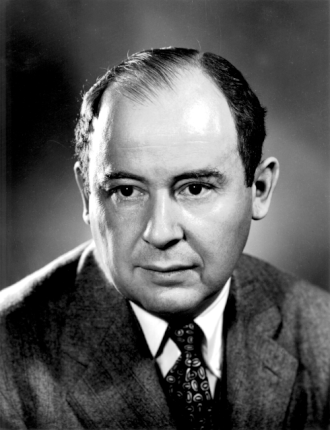 John von Neumann
"Children must be free to think in all directions irrespective of the peculiar ideas of parents who often seal their childrens minds with preconceived prejudices and false concepts of past generations. Unless we are very careful, very careful indeed, and very conscientious, there is still great danger that our children may turn out to be the same kind of people we are."