SHAWORDS

It would take me all night to tell about Old Bull Lee; lets just say n — William S. Burroughs

"It would take me all night to tell about Old Bull Lee; lets just say now, he was a teacher, and it may be said that he had every right to teach because he spent all his time learning; and the things he learned were what he considered to be and called "the facts of life," which he learned, not only out of necessity but because he wanted to. He dragged his long, thin body around the entire United States and most of Europe and North Africa in his time, only to see what was going on.... there are pictures of him with the international cocaine set of the thirties — gangs with wild hair, leaning on one another, there are other pictures of him in a Panama hat, surveying the streets of Algiers.... He was an exterminator in Chicago, a bartender in New York, a summons-server in Newark. In Paris he sat at cafe tables, watching the sullen French faces go by. In Athens he looked up from his ouzo at what he called the ugliest people in the world. In Istanbul he threaded his way through crowds of opium addicts and rug-sellers, looking for the facts. In Chicago he planned to hold up a Turkish bath, hesitated just for two minutes too long for a drink, and, wound up with two dollars and had to make a run for it. He did all these things merely for the experience...."
It would take me all night to tell about Old Bull Lee; lets just say now, he was a teacher, and it may be said that he h
W
William S. Burroughs
author84 quotes

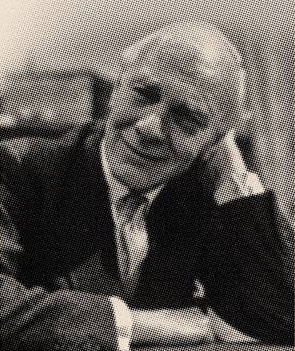
William Seward Burroughs II was an American writer and visual artist. He is widely considered a primary figure of the Beat Generation and a major postmodern author who influenced both underground and popular culture and literature. Much of Burroughs's work is highly experimental and features unreliable narrators. Also noted as semi-autobiographical, his work often drew from his experiences with dr

About William S. Burroughs

William Seward Burroughs II was an American writer and visual artist. He is widely considered a primary figure of the Beat Generation and a major postmodern author who influenced both underground and popular culture and literature. Much of Burroughs's work is highly experimental and features unreliable narrators. Also noted as semi-autobiographical, his work often drew from his experiences with dr

View all quotes by William S. Burroughs

More by William S. Burroughs

View all →
Quote
"The face of "evil" is always the face of total need. A dope fiend is a man in total need of dope. Beyond a certain frequency need knows absolutely no limit or control. In the words of total need: "Wouldnt you?" Yes you would. You would lie, cheat, inform on your friends, steal, do anything to satisfy total need. Because you would be in a state of total sickness, total possession, and not in a position to act in any other way. Dope fiends are sick people who cannot act other than they do. A rabid dog cannot choose but bite."
W
William S. Burroughs
Quote
"If you wish to alter or annihilate a pyramid of numbers in a serial relation, you alter or remove the bottom number. If we wish to annihilate the junk pyramid, we must start with the bottom of the pyramid: the Addict in the Street, and stop tilting quixotically for the "higher ups" so called, all of whom are immediately replaceable. The addict in the street who must have junk to live is the one irreplaceable factor in the junk equation. When there are no more addicts to buy junk there will be no junk traffic. As long as junk need exists, someone will service it."
W
William S. Burroughs

More on Life

View all →
Quote
"If it fulfills our hopes, this center will be, at once, a symbol and a reflection and a hope. It will symbolize our belief that the world of creation and thought are at the core of all civilization. Only recently in the White House we helped commemorate the 400th anniversary of Shakespeare. The political conflicts and ambitions of his England are known to the scholar and to the specialist. But his plays will forever move men in every corner of the world. The leaders that he wrote about live far more vividly in his words than in the almost forgotten facts of their own rule. Our civilization, too, will largely survive in the works of our creation. There is a quality in art which speaks across the gulf dividing man from man and nation from nation, and century from century. That quality confirms the faith that our common hopes may be more enduring than our conflicting hostilities. Even now men of affairs are struggling to catch up with the insights of great art. The stakes may well be the survival of civilization. The personal preferences of men in government are not important--except to themselves. However, it is important to know that the opportunity we give to the arts is a measure of the quality of our civilization. It is important to be aware that artistic activity can enrich the life of our people, which really is the central object of Government. It is important that our material prosperity liberate and not confine the creative spirit."
L
Lyndon B. Johnson
Quote
"I did not go to join Kurtz there and then. I did not. I remained to dream the nightmare out to the end, and to show my loyalty to Kurtz once more. Destiny. My destiny! Droll thing life is — that mysterious arrangement of merciless logic for a futile purpose. The most you can hope from it is some knowledge of yourself — that comes too late — a crop of unextinguishable regrets. I have wrestled with death. It is the most unexciting contest you can imagine. It takes place in an impalpable grayness, with nothing underfoot, with nothing around, without spectators, without clamor, without glory, without the great desire of victory, without the great fear of defeat, in a sickly atmosphere of tepid skepticism, without much belief in your own right, and still less in that of your adversary. If such is the form of ultimate wisdom, then life is a greater riddle than some of us think it to be. I was within a hairs-breadth of the last opportunity for pronouncement, and I found with humiliation that probably I would have nothing to say. This is the reason why I affirm that Kurtz was a remarkable man. He had something to say. He said it. Since I had peeped over the edge myself, I understand better the meaning of his stare, that could not see the flame of the candle, but was wide enough to embrace the whole universe, piercing enough to penetrate all the hearts that beat in the darkness. He had summed up — he had judged. The horror! He was a remarkable man. After all, this was the expression of some sort of belief; it had candor, it had conviction, it had a vibrating note of revolt in its whisper, it had the appalling face of a glimpsed truth — the strange commingling of desire and hate."
H
Heart of Darkness