SHAWORDS

Let AB be taken as unity, and let it be required to multiply BD by BC. — La Géométrie

"Let AB be taken as unity, and let it be required to multiply BD by BC. I have only to join the points A and C, and draw DE parallel to CA; then BE is the product of BD and BC. If it be required to divide BE by BD, I join E and D, and draw AC parallel to DE; then BC is the result of division."
La Géométrie
La Géométrie
La Géométrie
author28 quotes

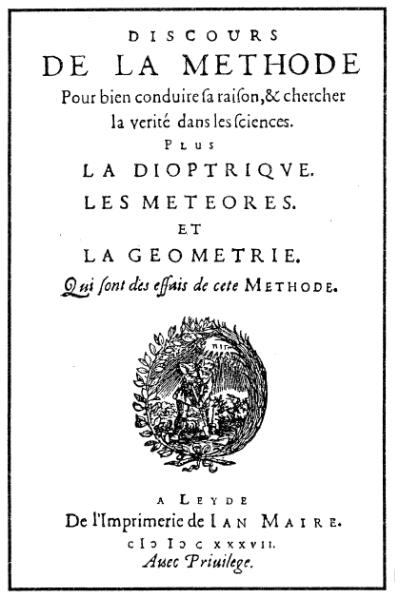
La Géométrie was published in 1637 as an appendix to Discours de la méthode, written by René Descartes. In the Discourse, Descartes presents his method for obtaining clarity on any subject. La Géométrie and two other appendices, also by Descartes, La Dioptrique (Optics) and Les Météores (Meteorology), were published with the Discourse to give examples of the kinds of successes he had achieved foll

More by La Géométrie

View all →
Quote
"Much of the obscurity was deliberate. Descartes boasted that few mathematicians in Europe would understand his work. He indicated the constructions and demonstrations, leaving to others to fill in the details. ...Many explanatory commentaries were written to make Descartess book clear. ...He says that he omits the the demonstrations of most of his general statements because if one takes the trouble to examine systematically these examples, the demonstrations of the general results will become apparent, and it is of more value to learn them that way."
La GéométrieLa Géométrie
Quote
"Suppose 3, 4, 5 or a greater number of lines to be given in position, required a point from which, drawing lines to the given lines, each making a given angle with them, the rectangles of two lines thus drawn from the given point may have a given ratio to the square on the third, if there are three; or to the rectangle of the two others, if there are four; or again, if there are five lines, that the of the two remaining lines, together with a third given line, or to the parallelopiped composed of the three others, if there are six; or again, if there are seven, that the algebraic product of the three others and a given line, or to the four others, if there are eight, and so on. This was a problem which very much perplexed the ancient geometricians. Pappus says that neither Euclid nor Apollonius could give a solution. He himself knew that when there are only three or four lines the locus was a , but he could not describe it, much less could he tell what the curve would be when the number of lines were more than four. When the number of lines were seven or eight, the ancients could scarcely enunciate the problem, for there are no figures beyond solids, and without the aid of algebra, it is impossible to conceive what the product of four lines can mean. It was this problem which Descartes successfully attacked, and which, most probably led him to apply algebra generally to geometry. The following solution is that given by Descartes with a few abbreviations: AB, AD, EF and GH (fig. 2) are the given lines, C the required point from which are drawn the lines CB, CD, CF and CH making given angles CBA, CDA, CFE, and CHG. AB (=x) and BC (=y) are the principal lines to which all the others will be referred. Suppose the given lines to meet CB in the points R, S, T, and AB in the points A, E and G. Let AE = c and AG = d... By the... method he found the equation to bey^2 + xy + x^2 - 2y -5x = 0;which he showed belonged to a circle."
La GéométrieLa Géométrie