Quote
"Life and literature is a question of what one thrills to, and further than that no man shall ever go without putting his foot in a turd."
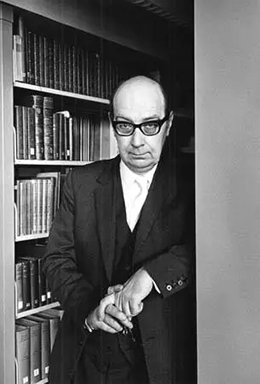 Philip Larkin
"Never such innocence, Never before or since, As changed itself to past Without a word — the men Leaving the gardens tidy, The thousands of marriages, Lasting a little while longer: Never such innocence again."
Philip Arthur Larkin was an English poet, novelist, and librarian. His first book of poetry, The North Ship, was published in 1945, followed by two novels, Jill (1946) and A Girl in Winter (1947). He came to prominence in 1955 with the publication of his second collection of poems, The Less Deceived, followed by The Whitsun Weddings (1964) and High Windows (1974). He contributed to The Daily Teleg
"Life and literature is a question of what one thrills to, and further than that no man shall ever go without putting his foot in a turd."
Philip Larkin"If we seriously contemplate life it appears an agony too great to be supported, but for the most part our minds gloss such things over & until the ice finally lets us through we skate about merrily enough. Most people, Im convinced, dont think about life at all. They grab what they think they want and the subsequent consequences keep them busy in an endless chain till theyre carried out feet first."
Philip Larkin"I never think of poetry or the poetry scene, only separate poems written by individuals."
Philip Larkin"To start at a new place is always to feel incompetent & unwanted."
Philip Larkin"You know I don’t care at all for politics, intelligently. I found that at school when we argued all we did was repeat the stuff we had, respectively, learnt from the Worker, the Herald, Peace News, the Right Book Club (that was me, incidentally: I knew these dictators, Marching Spain, I can remember them now) and as they all contradicted each other all we did was get annoyed. I came to the conclusion that an enormous amount of research was needed to form an opinion on anything, & therefore I abandoned politics altogether as a topic of conversation. It’s true that the writers I grew up to admire were either non-political or Left-wing, & that I couldn’t find any Right-wing writer worthy of respect, but of course most of the ones I admired were awful fools or somewhat fakey, so I don’t know if my prejudice for the Left takes its origin there or not. But if you annoy me by speaking your mind in the other interest, it’s not because I feel sacred things are being mocked but because I can’t reply, not (as usual) knowing enough. ... By the way, of course I’m terribly conventional, by necessity! Anyone afraid to say boo to a goose is conventional."
Philip Larkin"What was the rock my gliding childhood struck, And what bright unreal path has led me here?"
Philip Larkin"In the life of the mass-order, the culture of the generality tends to conform to the demands of the average human being. Spirituality decays through being diffused among the masses when knowledge is impoverished in every possible way by rationalisation until it becomes accessible to the crude understanding of all."
"I say this to you because we Spaniards are a forgetful people, because we are used to living for the moment, because we do not look back, because we do not know how to see the chain of heroes, because we do not contemplate the sum of sacrifices."
 Francisco Franco
"Sharon Tate was my best friend. Once, we were roommates. She introduced me to my husband. She was the godmother to my baby daughter who is named for her. In the six years time that I knew her, she never said an unkind word about anyone."
"Long time to see. (VS: Tapion)"
"Most mathematicians prove what they can, von Neumann proves what he wants." Once in a discussion about the rapid growth of mathematics in modern times, von Neumann was heard to remark that whereas thirty years ago a mathematician could grasp all of mathematics, that is impossible today. Someone asked him: "What percentage of all mathematics might a person aspire to understand today?" Von Neumann went into one of his five-second thinking trances, and said: "About 28 percent."
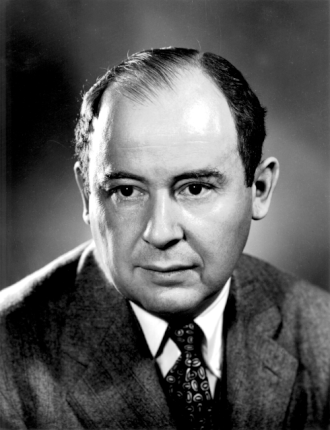 John von Neumann
"Children must be free to think in all directions irrespective of the peculiar ideas of parents who often seal their childrens minds with preconceived prejudices and false concepts of past generations. Unless we are very careful, very careful indeed, and very conscientious, there is still great danger that our children may turn out to be the same kind of people we are."