Quote
"There is no odor so bad as that which arises from goodness tainted."
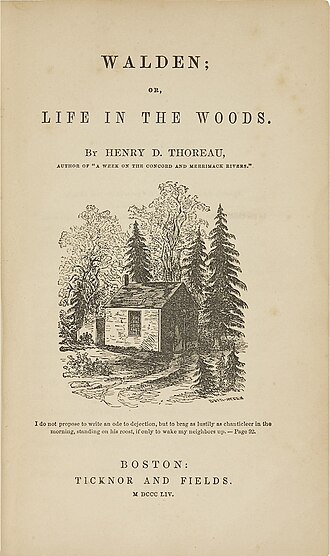 Walden
"Often if an accident happens to a gentlemans legs, they can be mended; but if a similar accident happens to the legs of his pantaloons, there is no help for it; for he considers, not what is truly respectable, but what is respected."
Walden is an 1854 book by American transcendentalist writer Henry David Thoreau. The text is a reflection upon the author's simple living in natural surroundings. The work is part personal declaration of independence, social experiment, voyage of spiritual discovery, satire, and—to some degree—a manual for self-reliance.
Walden is an 1854 book by American transcendentalist writer Henry David Thoreau. The text is a reflection upon the author's simple living in natural surroundings. The work is part personal declaration of independence, social experiment, voyage of spiritual discovery, satire, and—to some degree—a manual for self-reliance.
View all quotes by Walden"There is no odor so bad as that which arises from goodness tainted."
Walden"We do not ride on the railroad; it rides upon us."
Walden"To the dark immensity of material Natures indifference we can oppose only the brief light, like a lamp in a cabin, of our consciousness; the invigorating benison of Walden is to make us feel that the contest is equal, and fair."
Walden"These beans have results which are not harvested by me. Do they not grow for woodchucks partly?"
Walden"Now only a dent in the earth marks the site of these dwellings, with buried cellar stones, and strawberries, raspberries, thimble-berries, hazel-bushes, and sumachs growing in the sunny sward there; some pitch pine or gnarled oak occupies what was the chimney nook, and a sweet-scented black birch, perhaps, waves where the door-stone was. Sometimes the well dent is visible, where once a spring oozed; now dry and tearless grass; or it was covered deep -- not to be discovered till some late day -- with a flat stone under the sod, when the last of the race departed. What a sorrowful act must that be -- the covering up of wells! coincident with the opening of wells of tears. These cellar dents, like deserted fox burrows, old holes, are all that is left where once were the stir and bustle of human life, and "fate, free will, foreknowledge absolute," in some form and dialect or other were by turns discussed. But all I can learn of their conclusions amounts to just this, that "Cato and Brister pulled wool"; which is about as edifying as the history of more famous schools of philosophy."
Walden"I have learned that the swiftest traveller is he that goes afoot."
Walden