SHAWORDS

Our core ecological problem is not climate change. It is overshoot, of — Richard Heinberg

"Our core ecological problem is not climate change. It is overshoot, of which global warming is a symptom. Overshoot is a systemic issue. Over the past century-and-a-half, enormous amounts of cheap energy from fossil fuels enabled the rapid growth of resource extraction, manufacturing, and consumption; and these in turn led to population increase, pollution, and loss of natural habitat and hence biodiversity. The human system expanded dramatically, overshooting Earth’s long-term carrying capacity for humans while upsetting the ecological systems we depend on for our survival. Until we understand and address this systemic imbalance, symptomatic treatment (doing what we can to reverse pollution dilemmas like climate change, trying to save threatened species, and hoping to feed a burgeoning population with genetically modified crops) will constitute an endlessly frustrating round of stopgap measures that are ultimately destined to fail."
Richard Heinberg
Richard Heinberg
Richard Heinberg
author6 quotes

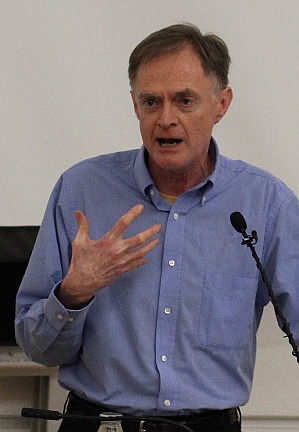
Richard William Heinberg is an American journalist and educator who has written on energy, economic, and ecological issues, including oil depletion. He is the author of 14 books, and is the senior fellow at the Post Carbon Institute.

More by Richard Heinberg

View all →
Quote
"We’ve spent the last few million years evolving big brains, and we won’t un-evolve them in short order. Further, encouraging dull-wittedness and ignorance would result in terrible short-term consequences (as we Americans are likely to discover during the second Trump presidency). Moreover, intelligence is cool: it gives us art, music, literature, science, mathematics, and so much more. At least some of these achievements and abilities are arguably worth saving. So, what’s our best long-term plan to avert self-destruction, given that intelligence is now baked into our species? There are those who say the solution lies in realizing that we fixate on just one kind of intelligence—linguistic, rational thinking—to the exclusion of others, and that we’d be better served by nurturing multiple intelligences, including musical, interpersonal, intrapersonal, spatial, bodily-kinesthetic, naturalist, and logical-mathematical. That’s good advice as far as it goes. But we’re unlikely to heed it sufficiently until we acknowledge why we came to rely so much on linguistic intelligence in the first place: it gave us power over our environment and over one another. So, our dilemma is as much one of ends (power) as means (language-based intelligence). In addition to needing a counterbalance to linguistic intelligence, we also need a way to check our individual and collective pursuit of excessive power."
Richard HeinbergRichard Heinberg
Quote
"The world, our world, finds itself caught between a rock and hard place. The relationship that we humans have developed with fossil energy over the last 250 years is a textbook definition of an addiction, and increasingly looks like a Faustian pact: we know that it’s slowly killing us, we know we should be leaving it in the ground and we also know that we will someday have to live without it anyway, yet we just can’t stop burning it and we can’t get enough of it, because we have multiplied our numbers and built our whole world around it. The detox “replacement medications” that we are using do not seem to be working so far, even as we keep increasing their doses. We are of course “pledging” to try harder and harder in the future, yet we keep relapsing into our fossil addiction, year after year, day after day, one flight at a time, one car ride at a time, one purchase at a time, one degree of comfort or of convenience at a time. By doing so we keep turning our eyes and minds away from the real nature of the upcoming and inevitable “energy transition”, the only one that is in fact likely to happen in our lifetimes, and which as Richard Heinberg said will almost certainly be a transition “from using a lot to using a lot less”."
Richard HeinbergRichard Heinberg
Quote
"Using science, technology, and cheap energy, we expanded farmlands, chain-sawed forests, exploited fisheries, mined minerals, pumped oil, and flattened mountains for their buried coal. And we did these things in a way that was not remotely sustainable. By harvesting renewable resources faster than they could regrow, by using non-renewable resources that could not be recycled, and by choking environments with industrial wastes, we were borrowing from future generations and from other species."
Richard HeinbergRichard Heinberg
Quote
"During the last 200 years, per capita energy usage grew eight-fold, while human population expanded at about the same rate. As a result of energy growth, all the things we do with energy became more doable. Transportation, manufacturing, agriculture, and mining exploded in scale. Energy became so abundant that it seemed we could solve any human problem, now or in the future, just by throwing more energy at it. We even reconfigured our economic system so that it assumes and requires perpetual growth. But growth in fossil-fuel energy can’t continue much longer: depletion and climate change will see to that. And even if we make a wholehearted effort to switch to low-carbon energy sources, we face limits to nature’s supplies of materials with which to make solar panels, wind turbines, nuclear reactors, and batteries."
Richard HeinbergRichard Heinberg
Quote
"Intelligence is useful and entertaining. Companies go out of their way to hire applicants with high IQ scores, and spectacular intellectual achievements in the arts and sciences can win the hero-worship of generations ([like] Aristotle, Bach, Einstein). Measuring smarts is the job of an industry. Indeed, smartness is so endlessly praised in modern society that questioning its value may constitute one of the most dissident of human acts. High intelligence has been defined in many ways, but typically as the capacity for abstraction, logic, self-awareness, learning, planning, creativity, critical thinking, and problem-solving. High intelligence values itself, selects for itself, and fascinates itself. Our remarkable human intellectual achievements are deeply tied to language, whose development occurred as a self-reinforcing evolutionary feedback process. Hundreds of thousands of years ago, early humans derived a collective survival advantage by developing precursors of language, which enabled them to coordinate their behavior and to plan. But language requires extra brain power, so natural selection also worked to increase brain size, which enabled further development of language, which conferred still more survival advantages, and so on. If evolution produced high intelligence, then high intelligence is latent in evolution. Yet high intelligence is quite rare in nature. While all species communicate to some degree, only one has developed abstract, symbolic language. If language-based high intelligence offers survival advantages, why has it cropped up in nature only once?"
Richard HeinbergRichard Heinberg