"The measures taken during the war by our military agencies, in restricting the free intercourse among scientists on related projects or even on the same project have gone so far that it is clear that if continued in time of peace, this policy will lead to the total irresponsibility of the scientist, and, ultimately, to the death of science. ...The interchange of ideas, which is one of the greatest traditions of science, must of course receive certain limitations when the scientist becomes an arbiter of life and death. ..."
Scientific discovery consists in the interpretation for our own conven — Norbert Wiener
"Scientific discovery consists in the interpretation for our own convenience of a system of existence which has been made with no eye to our convenience at all. One of the chief duties of a mathematician in acting as an advisor to scientists is to discourage them from expecting too much of mathematicians."

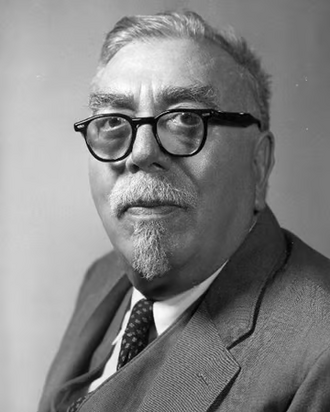
Norbert Wiener was an American computer scientist, mathematician, and philosopher. He became a professor of mathematics at the Massachusetts Institute of Technology (MIT). A child prodigy, Wiener later became an early researcher in stochastic and mathematical noise processes, contributing work relevant to electronic engineering, electronic communication, and control systems.
View all quotes by Norbert WienerMore by Norbert Wiener
View all →"In the past, the community of scholars has made it a custom to furnish scientific information to any person seriously seeking it. However, we must face these facts: The policy of the government itself during and after the war, say in the bombing of Hiroshima and Nagasaki, has made it clear that to provide scientific information is not a necessarily innocent act, and may entail the gravest consequences. One therefore cannot escape reconsidering the established custom of the scientist to give information to every person who may inquire of him."
"The terms "black box" and "white box" are convenient and figurative expressions of not very well determined usage. I shall understand by a black box a piece of apparatus, such as four-terminal networks with two input and two output terminals, which performs a definite operation on the present and past of the input potential, but for which we do not necessarily have any information of the structure by which this operation is performed. On the other hand, a white box will be similar network in which we have built in the relation between input and output potentials in accordance with a definite structural plan for securing a previously determined input-output relation."
"Let it be remarked ... that an important difference between the way in which we use the brain and the machine is that the machine is intended for many successive runs, either with no reference to each other, or with a minimal, limited reference, and that it can be cleared between such runs; while the brain, in the course of nature, never even approximately clears out its past records. Thus the brain, under normal circumstances, is not the complete analogue of the computing machine but rather the analogue of a single run on such a machine. We shall see later that this remark has a deep significance in psychopathology and in psychiatry."
"As to sociology and anthropology, it is manifest that the importance of information and communication as mechanisms of organization proceeds beyond the individual into the community. On the other hand, it is completely impossible to understand social communities such as those of ants without a thorough investigation of their means of communication, and we were fortunate enough to have the aid of Dr. Schneirla in this matter. For the similar problems of human organization, we sought help from the anthropologists Drs. Bateson and Margaret Mead; while Dr. Morgenstern of the Institute for Advanced Study was our adviser in the significant field of social organization belong to economic theory. His very important joint book on games with Dr. von Neumann, by the way, represents a most interesting study of social organization from the point of view of methods closely related to, although distinct from, the subject matter of cybernetics. Dr. Lewin and others represented the newer work on the theory of opinion sampling and the practice of opinion making, and Dr. F. C. S. Northrup was interested in assaying the philosophical significance of our work."
"The odors perceived by the ant seem to lead to a highly standardized course of conduct; but the value of a simple stimulus, such as an odor, for conveying information depends not only on the information conveyed by the stimulus itself but on the whole nervous constitution of the sender and receiver of the stimulus as well. Suppose I find myself in the woods with an intelligent savage who cannot speak my language and whose language I cannot speak. Even without any code of sign language common to the two of us, I can learn a great deal from him. All I need to do is to be alert to those moments when he shows the signs of emotion or interest. I then cast my eyes around, perhaps paying special attention to the direction of his glance, and fix in my memory what I see or hear. It will not be long before I discover the things which seem important to him, not because he has communicated them to me by language, but because I myself have observed them. In other words, a signal without an intrinsic content may acquire meaning in his mind by what he observes at the time, and may acquire meaning in my mind by what I observed at the time. The ability that he has to pick out the moments of my special, active attention is in itself a language as varied in possibilities as the range of impressions that the two of us are able to encompass. Thus social animals may have an active, intelligent, flexible means of communication long before the development of language."
More on Courage
View all →"The true Vedantic spirit does not start out with a system of preconceived ideas. It possesses absolute liberty and unrivalled courage among religions with regard to the facts to be observed and the diverse hypotheses it has laid down for their coordination. Never having been hampered by a priestly order, each man has been entirely free to search wherever he pleased for the spiritual explanation of the spectacle of the universe."
"The decades-long draconian approach of the international community to preventing drug dependence is now widely recognised to have been a human disaster, both in the failure to tackle the primary issue and for the additional human suffering caused, including the patients in moderate to severe pain who have been prevented from accessing essential medicines. We need politicians and policymakers to be courageous enough to admit that past policies were misguided, and to rebalance their priorities and approaches in ways that will reduce human suffering."
"O may I join the choir invisible Of those immortal dead who live again In minds made better by their presence; live In pulses stirred to generosity, In deeds of daring rectitude, in scorn For miserable aims that end with self, In thoughts sublime that pierce the night like stars, And with their mild persistence urge mens search To vaster issues."
"There is no question that religions have historically played the role of making people contented with their lot. ...such a doctrine would be very appealing to the ruling classes of a society. ...Many societies, for this reason alone, encourage the contentment with your lot that the religious premise of heaven affords."
"Value of a man depends upon his courage; his veracity depends upon his self-respect and his chastity depends upon his sense of honor."
"What counts most is holding on. The growth of a train of thought is not a direct forward flow. There is a succession of spurts separated by intervals of stagnation, frustration, and discouragement. If you hold on, there is bound to come a certain clarification. The unessential components drop off and a coherent, lucid whole begins to take shape."