SHAWORDS

So for now, depleted uranium falls into the quagmire of Gulf War Syndr — Gulf War

HomeGulf WarQuote
"So for now, depleted uranium falls into the quagmire of Gulf War Syndrome, from which no treatment has emerged despite the governments spending of at least $300 million. About 30 percent of the 700,000 men and women who served in the first Gulf War still suffer a baffling array of symptoms very similar to those reported by Reeds unit."
Gulf War
Gulf War
Gulf War
author22 quotes

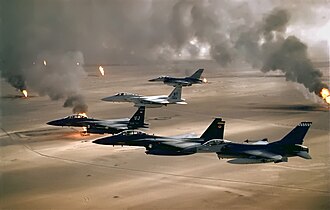
The Gulf War was an armed conflict between Iraq and a 42-country coalition led by the United States. The coalition's efforts were in two phases: Operation Desert Shield, which marked the military buildup from August 1990 to January 1991; and Operation Desert Storm, from the bombing campaign against Iraq on 17 January until the American-led liberation of Kuwait on 28 February.

More by Gulf War

View all →
Quote
"I do not agree with Iraq`s war against Kuwait. Iraq may have a historical claim but many of us have historical claims over neighbouring lands. Malaysia has a claim over Southern Thailand. But that was history. We have accepted that it is part of Thailand and we will say nothing more about it. We will not support insurrections against Thailand. Surely Iraq must accept that Kuwait is now independent. But the fact is that Iraq attacked Kuwait and subsequently lost to a so-called international force. The attacking army could have advanced and captured the leader of Iraq. But it did not. Instead the so-called liberators of Kuwait imposed all kinds of restrictions on Iraq, restrictions which punished the civilians, the children, the old, the sick, the women. For ten long years the people of Iraq were made to suffer because its leader is not liked by the West."
Gulf WarGulf War
Quote
"Just as in Pakistan, where Zia had to repeatedly, continuously subjugate critics with violence to stay on top, so Hezbollah would have to repeatedly beat down opponents. In July 1990, just months before the official end of the war in Lebanon, thousands demonstrated in Tyre. “We want to speak the truth!” they chanted. “We don’t want to see any Iranians!” Lebanese Shia clerics called for the end of the “Iranian invasion” and the departure of the Revolutionary Guards who had come to the Beqaa Valley after the 1982 Israeli invasion and still maintained a presence. But the Guards could in fact leave; Hezbollah, their local affiliate, was in place. And by allowing Assad to send troops into Lebanon, America had unwittingly provided a way for his ally Iran to maintain its foothold on the Mediterranean. The black wave from Iran would not recede."
Gulf WarGulf War
Quote
"A small but recurrent component of media reports on Iraq and Kuwait during the period from the Iraq invasion of Kuwait on 2 August 1990 through the Gulf War and its aftermath dealt with archaeology in the region and the potential and actual impact of the war on archaeological remains. An index of the saliece of archaeology for formulating the meaning of the war is that one of the first editorials printed in the New York Times the day after the bombing of Baghdad began (19 Jan. 1991) centered on thus subject. Entitled The Cradle, Ironically, of Civilization, it warned the US military against bombing cities, religious shrines or renowned archaeological sites but went on to focus entirely on the prehistoric sites. It used descriptors that were to recur constantly throughout media coverage of the arhcaeology of the region, describing Ur, for example, as the very cradle of civilization and the birthplace of Abraham, and evoking images of ancient, unexplored, and sacred cities scattered through Iraq. Why did archaeological remains have this centrality? In a society still; enamored of an evolutionary view of human societies, did the story of a glorious Iraqi past get its power through the devolutionary reversals it displayed, its clear legitimizing unction for an avenging Allied campaign to preserve or even restore what was referred to as our common heritage? Did ancient artifacts, like incubator babies of Kuwait, allow for narratives of innocence in a story that was otherwise too full of moral responsibility - with evil or invisible Iraqis, noble Allies and victimized Kuwaitis? Or, has the fetishizing of the commodity in our society grown over time to such a point that artifact survivors become more important that human Iraqi ones?"
Gulf WarGulf War