SHAWORDS

[...] we can strip off all grammatical clues to sentence structure, al — Colin Cherry

HomeColin CherryQuote
"[...] we can strip off all grammatical clues to sentence structure, all affixes and prepositions, and yet still achieve communication. Thus restricted to nouns, simple "stories" can be told in word chains: Woman, street, crowd, traffic, noise, haste, thief, bag, loss, scream, police.... Again, the readers past experience of his language is sufficient to restore the missing elements, sufficiently accurately for the purpose. But of course, not only does the reader have experience of sentence structure, enabling him to supply the missing syntactical elements, but also he has experience of typical contexts in which the various words are used; many words bear an aura about with them. It might be more difficult to tell a tale about a policeman who robbed a woman, for instance, with so little redundancy! (p.122)"
C
Colin Cherry
Colin Cherry
author11 quotes

Edward Colin Cherry was a British cognitive scientist whose main contributions were in focused auditory attention, specifically the cocktail party problem regarding the capacity to follow one conversation while many other conversations are going on in a noisy room. Cherry used shadowing tasks to study this problem, which involve playing two different auditory messages to a participant's left and r

More by Colin Cherry

View all →
Quote
"As we survey the various stages of evolution, from the simplest one-cell creatures up to man. we see a steady improvement in the methods of learning and adaptation to a hostile world. Each step in learning ability gives better adaptation and greater chance of survival. We are carried a long way up the scale by innate reflexes and rudimentary muscular learning faculties. Habits indeed, not rational thought, assist us to surmount most of lifes obstacles. Most, but by no means all; for learning in the high mammals exhibits the unexplained phenomenon of "insight," which shows itself by sudden changes in behavior in learning situations -- in sudden departures from one method of organizing a task, or solving a problem, to another.Hebb, D. O., The Organization of Behavior, John Wiley & Sons, Inc., New York, 1949. Insight, expectancy, set, are the essentially "mind-like" attributes of communication, and it is these, together with the representation of concepts, which require physiological explanation. At the higher end of the scale of evolution, this quality we call "mind" appears more and more prominently, but it is at our own level that learning of a radically new type has developed -- through our powers of organizing thoughts, comparing and setting them into relationship, especially with the use of language. We have a remarkable faculty of forming generalizations, of recognizing universals, of associating and developing them. It is our multitude of general concepts, and our powers of organizing them with the aid of language in varied ways, which forms the backbone of human communication, and which distinguishes us from the animals. (p. 304)"
C
Colin Cherry

More on Time

View all →
Quote
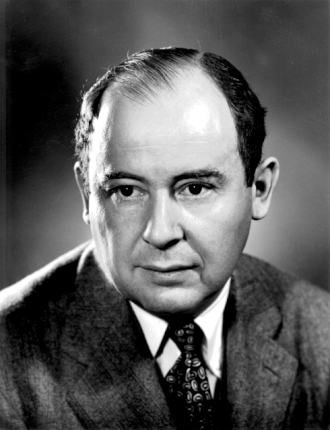
"Most mathematicians prove what they can, von Neumann proves what he wants." Once in a discussion about the rapid growth of mathematics in modern times, von Neumann was heard to remark that whereas thirty years ago a mathematician could grasp all of mathematics, that is impossible today. Someone asked him: "What percentage of all mathematics might a person aspire to understand today?" Von Neumann went into one of his five-second thinking trances, and said: "About 28 percent."
John von NeumannJohn von Neumann