SHAWORDS

That one man can run faster than another is no reason to prevent the l — Harry V. Jaffa

"That one man can run faster than another is no reason to prevent the latter from entering the race. Indeed, until the race is run, how do we know who can run faster? In comparing the known inequalities among whites to the alleged inequalities between blacks and whites, Wilson illuminates the logical and moral irrelevance of the distinction of the races in considering the principles of republican government. Nevertheless, this topic could not be addressed in the pure light of reason and nature, because public opinion, North or South, would not permit it."
That one man can run faster than another is no reason to prevent the latter from entering the race. Indeed, until the ra
Harry V. Jaffa
Harry V. Jaffa
Harry V. Jaffa
author26 quotes

Harry Victor Jaffa was an American political philosopher, historian, columnist, and professor. He was a professor emeritus at Claremont McKenna College, Claremont Graduate University, and was a distinguished fellow of the Claremont Institute. Robert P. Kraynak says his "life work was to develop an American application of Leo Strauss's revival of natural-right philosophy against the relativism and

About Harry V. Jaffa

Harry Victor Jaffa was an American political philosopher, historian, columnist, and professor. He was a professor emeritus at Claremont McKenna College, Claremont Graduate University, and was a distinguished fellow of the Claremont Institute. Robert P. Kraynak says his "life work was to develop an American application of Leo Strauss's revival of natural-right philosophy against the relativism and

View all quotes by Harry V. Jaffa

More by Harry V. Jaffa

View all →
Quote
"In the Lincoln-Douglas debates, Lincoln accomplished something almost miraculous. That is to say, what he had to do was to fight off the challenge of Douglas from the Republican side and at the same time drive a wedge between Douglas and the Southern Democrats. I compared his achievement in that to Stonewall Jackson’s Valley Campaign, where Jackson fought two federal armies, beat them both and kept them close to Washington while he joined Lee before Richmond for the final battle of the seven days. It was a case of technical and strategic cleverness and profundity that is, I think, perhaps almost unrivaled in world history."
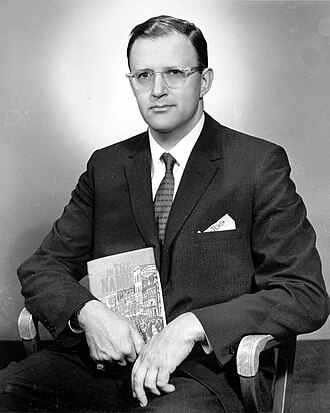
Harry V. JaffaHarry V. Jaffa
Quote
"On the question of the tariff, it may come as news to Professor DiLorenzo that the protective tariffs were first instituted by Jefferson and Madison, not by the Hamiltonian party. Hamilton tried to get the tariffs, but he was not successful. And the reason why, the protective tariffs first entered our system in the wake of Jefferson’s embargo, which put the New England shipping interests out of business. And so the first protective tariffs were put in, I think, under Madison’s administration, and supported by John C. Calhoun, who agreed that at that time it was owed to the New England people to give their infant industries protection because they had been put out of business by the embargo, and later by the War of 1812, conducted under Madison’s administration."
Harry V. JaffaHarry V. Jaffa
Quote
"As far as Hamilton, the banks and internal improvements, contrary to Professor DiLorenzo, I think, and several other people have thought, that Hamilton was the greatest Secretary of the Treasury we ever had. The assumption of the debts of the states, and the funding of the debt through the bank produced an enormous prosperity in the country, and this was all done under Washington’s administration. And if you want to speak of Federalists and people supporting the Federalist economic agenda, the first one of them was George Washington."
Harry V. JaffaHarry V. Jaffa
Quote
"Now there’s document on a subject of states rights and states sovereignty which is very seldom cited but which is absolutely fundamental to understanding the status of sovereignty under the Constitution: the letter that George Washington wrote transmitting the new Constitution to the Congress on September 17, 1787. And among the ironies of this letter is the fact that John C. Calhoun in his Discourse on the Constitution and Government of the United States, the sequel to his Disquisition on Government, cites the words that Washington used to support his position that this was a federal government, and that “federal” meant one in which the constituent parts retains complete sovereignty. And he refers to the fact that Washington refers to “the federal government of these States.”"
Harry V. JaffaHarry V. Jaffa
Quote
"Now, the truth of the matter is that the idea of the meaning of the word federal underwent a change from the Articles of Confederation to the Constitution. Under the Constitution, the states gave up their sovereignty in the Calhounian sense. And if you have any doubt about that, let me just read a sentence from George Washington. It is obviously impracticable in the federal government of these states to secure all rights of independent sovereignty to each, and yet provide for the interest and safety of all. So all the rights of independent sovereignty, or some of those rights, have been surrendered."
Harry V. JaffaHarry V. Jaffa