SHAWORDS

The first deterrence, nuclear deterrence, is presently being supersede — Paul Virilio

HomePaul VirilioQuote
"The first deterrence, nuclear deterrence, is presently being superseded by the second deterrence: a type of deterrence based on what I call the information bomb associated with the new weaponry of information and communications technologies. Thus, in the very near future, and I stress this important point, it will no longer be war that is the continuation of politics by other means, it will be what I have dubbed the integral accident that is the continuation of politics by other means."
P
Paul Virilio
Paul Virilio
author8 quotes

Paul Virilio was a French cultural theorist, urbanist, architect and aesthetic philosopher. He is best known for his writings about technology as it has developed in relation to speed and power, with diverse references to architecture, the arts, the city and the military. Virilio was a prolific creator of neologisms, most notably his concept of "dromology", the all-around, pervasive inscription of

More by Paul Virilio

View all →
Quote
"a caste of "technology monks" is being created in our times, and that there exist monasteries of sorts whose goal it is to pave the way for a new kind of "civilisation"; one that has nothing to do with civilisation as we remember it. The work of these technology monks is not carried out in the way that it was in the Middle Ages. Rather, it is carried out through the revaluation of knowledge, like that achieved for Antiquity. The contribution of monks to the rediscovery of Antiquity is well known... And with information monotheism comes what I think of as the greatest danger of all, the slide into a future without humanity."
P
Paul Virilio

More on Time

View all →
Quote
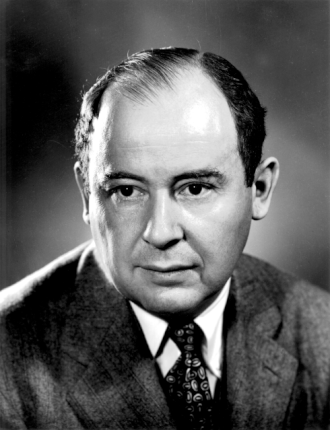
"Most mathematicians prove what they can, von Neumann proves what he wants." Once in a discussion about the rapid growth of mathematics in modern times, von Neumann was heard to remark that whereas thirty years ago a mathematician could grasp all of mathematics, that is impossible today. Someone asked him: "What percentage of all mathematics might a person aspire to understand today?" Von Neumann went into one of his five-second thinking trances, and said: "About 28 percent."
John von NeumannJohn von Neumann