Quote
"γεωμετρῆσαι βούλομαι τὸν ἀέρα ὑμῖν διελεῖν τε κατὰ γύας."
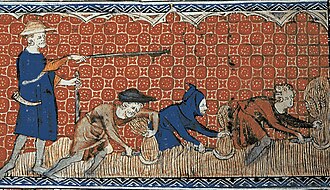 Enclosure
"The first man who, having enclosed a piece of land, thought of saying ‘This is mine’ and found people simple enough to believe him, was the true founder of civil society. How many crimes, wars, murders; how much misery and horror the human race would have been spared if someone had pulled up the stakes and filled in the ditch and cried out to his fellow men: ‘Beware of listening to this impostor. You are lost if you forget that the fruits of the earth belong to everyone and the earth itself belongs to no one!”"
Enclosure or inclosure is a term, used in English landownership, that refers to the appropriation of "waste" or "common land", enclosing it, and by doing so depriving commoners of their traditional rights of access and usage. Agreements to enclose land could be either through a formal or informal process. The process could normally be accomplished in three ways. First there was the creation of "cl
"γεωμετρῆσαι βούλομαι τὸν ἀέρα ὑμῖν διελεῖν τε κατὰ γύας."
Enclosure"Enclosure, once accepted, redefines community. Enclosure undermines the local autonomy of community. ... Enclosure allows the bureaucrats to define local community as impotent ... to provide for its own survival. People become economic individuals that depend for their survival on commodities that are produced for them. Fundamentally, most citizens movements represent a rebellion against this environmentally induced redefinition of people as consumers."
Enclosure"Stop to consider how the so-called owners of the land got hold of it. They simply seized it by force, afterwards hiring lawyers to provide them with title-deeds. In the case of the enclosure of the common lands, which was going on from about 1600 to 1850, the land-grabbers did not even have the excuse of being foreign conquerors; they were quite frankly taking the heritage of their own countrymen, upon no sort of pretext except that they had the power to do so."
Enclosure"Violence, fraud, the prerogative of force, the claims of superior cunning—those are the sources to which titles may be traced. The original deeds were written with the sword, rather than with the pen; not lawyers, but soldiers, were the conveyancers; blows were the current coin given in payment; and for seals, blood was used in preference to wax. Could valid claims be thus constituted? Hardly. And if not, what becomes of the pretensions of all subsequent holders of estates so obtained? Does sale or bequest generate a right where it did not previously exist?"
Enclosure"As Nozick acknowledges, a modern state should not feel morally constrained by property holdings which might have had a Lockean pedigree but in fact do not. In this regard it is interesting that one of the main uses of Lockean theory these days is in defending the property rights of indigenous people—where a literal claim is being made about who had first possession of a set of resources and about the need to rectify the injustices that accompanied their subsequent expropriation."
Enclosure"The problems with software are just examples of the problems found generally with creativity. Our trend in copyright law has been to enclose as much as we can; the consequence of this enclosure is a stifling of creativity and innovation. If the Internet teaches us anything, it is that great value comes from leaving core resources in a commons, where theyre free for people to build upon as they see fit."
Enclosure