Quote
"Notre raison est toujours déçue par linconstance des apparences."
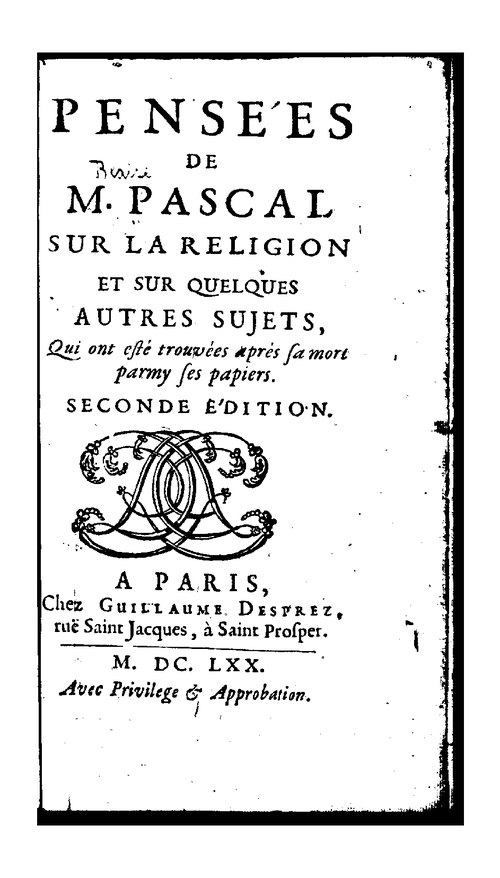 Pensées
"The imagination enlarges little objects so as to fill our souls with a fantastic estimate; and, with rash insolence, it belittles the great to its own measure, as when talking of God."
The Pensées (Thoughts) is a collection of fragments written by the French 17th-century philosopher and mathematician Blaise Pascal. Pascal's religious conversion led him into a life of asceticism, and the Pensées was in many ways his life's work. It represented Pascal's defense of the Christian religion, and the concept of "Pascal's wager" stems from a portion of this work.
"Notre raison est toujours déçue par linconstance des apparences."
Pensées"There are then two kinds of intellect: the one able to penetrate acutely and deeply into the conclusions of given premises, and this is the precise intellect; the other able to comprehend a great number of premises without confusing them, and this is the mathematical intellect. The one has force and exactness, the other comprehension. Now the one quality can exist without the other; the intellect can be strong and narrow, and can also be comprehensive and weak."
Pensées"Those who are accustomed to judge by feeling do not understand the process of reasoning, for they would understand at first sight, and are not used to seek for principles. And others, on the contrary, who are accustomed to reason from principles, do not at all understand matters of feeling, seeking principles, and being unable to see at a glance."
Pensées"La vraie éloquence se moque de léloquence, la vraie morale se moque de la morale."
Pensées"...it is to judgment that perception belongs, as science belongs to intellect. Intuition is the part of judgment, mathematics of intellect."
Pensées"Man loves malice, but not against one-eyed men nor the unfortunate, but against the fortunate and proud."
Pensées