"Optimism is normal, but some fortunate people are more optimistic than the rest of us. If you are genetically endowed with an optimistic bias, you hardly need to be told that you are a lucky person -- you already feel fortunate. Optimistic people play a disproportionate role in shaping our lives. Their decisions make a difference; they are inventors, entrepreneurs, political and military leaders -- not average people. They got to where they are by seeking challenges and taking risks. They are talented and they have been lucky, almost certainly luckier than they acknowledge."
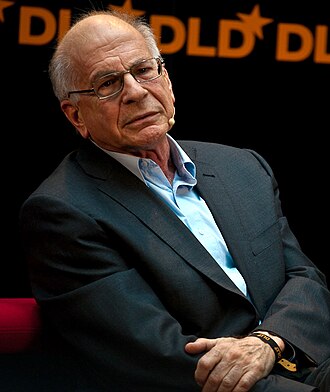
The lesson is clear: estimates of causes of death are warped by media — Daniel Kahneman
"The lesson is clear: estimates of causes of death are warped by media coverage. [...] The world in our heads is not a precise replica of reality; our expectations about the frequency of events are distorted by the prevalence and emotional intensity of the messages to which we are exposed."

Daniel Kahneman was an Israeli-American psychologist best known for his work on the psychology of judgment and decision-making as well as behavioral economics, for which he was awarded the 2002 Nobel Memorial Prize in Economic Sciences together with Vernon L. Smith. Kahneman's published empirical findings challenge the assumption of human rationality prevailing in modern economic theory. Kahneman
View all quotes by Daniel KahnemanMore by Daniel Kahneman
View all →"A huge part of Dannys work is on how we think – and how profoundly irrational we can be. That, too, is transforming business, however slowly, and explains the million copies he has sold of his new book. But, in the great sweep of history, I suspect he will be most remembered as the man who made happiness respectable."
"People who make a difference do not die alone. Something dies in everyone who was affected by them. Amos made a great deal of difference, and when he died, life was dimmed and diminished for many of us. There is less intelligence in the world. There is less wit. There are many questions that will never be answered with the same inimitable combination of depth and clarity. There are standards that will not be defended with the same mix of principle and good sense. Life has become poorer. There is a large Amos-shaped gap in the mosaic, and it will not be filled. It cannot be filled because Amos shaped his own place in the world, he shaped his life, and even his dying. And in shaping his life and his world, he changed the world and the life of many around him."
"Theres literally no difference between a physician recognizing a disease from a "facial expression", and a little child pointing to something and saying "doggie"."
"An experiment about your next vacation will allow you to observe your attitude to your experiencing self: At the end of the vacation, all pictures and videos will be destroyed. Furthermore, you will swallow a potion that will wipe out all your memories of the vacation. How would this affect your vacation plans? How much would you be willing to pay for it, relative to a normally memorable vacation? My impression is that the elimination of memories greatly reduces the value of the experience.Imagine a painful operation during which you will scream in pain and beg the surgeon to stop. However, you are promised an amnesia-inducing drug that will wipe out any memory of the episode. Here again, my observation is that most people are remarkably indifferent to the pains of their experiencing self. Some say they don’t care at all. Others share my feeling, which is that I feel pity for my suffering self but not more than I would feel for a stranger in pain.I am my remembering self, and the experiencing self, who does my living, is like a stranger to me."
"Many unfortunate human situations unfold [...] where people who face very bad options take desperate gambles, accepting a high probability of making things worse in exchange for a small hope of avoiding a large loss. Risk taking of this kind often turns manageable failures into disasters."