SHAWORDS

The overt message is that preventing nuclear proliferation is importan — Mohamed ElBaradei

"The overt message is that preventing nuclear proliferation is important...but I think there is a covert message as well: that it is a good idea to have ElBaradei at the IAEA because he was right about Iraq and the administration was wrong... It cannot escape peoples attention that this was the man who stood up against the United States and said that Iraq was not reconstituting its nuclear program."
The overt message is that preventing nuclear proliferation is important...but I think there is a covert message as well:
Mohamed ElBaradei
Mohamed ElBaradei
Mohamed ElBaradei
author36 quotes

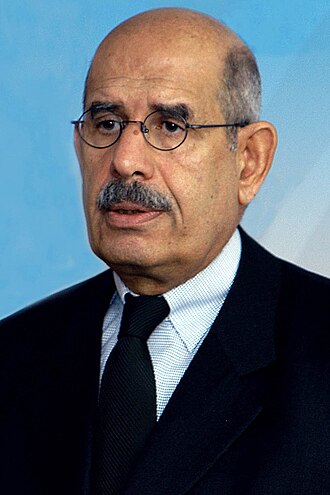
Mohamed Mostafa ElBaradei is an Egyptian lawyer and diplomat who served as Director General of the International Atomic Energy Agency (IAEA) from 1997 to 2009, then as vice president of Egypt on an interim basis from 14 July to 14 August 2013.

About Mohamed ElBaradei

Mohamed Mostafa ElBaradei is an Egyptian lawyer and diplomat who served as Director General of the International Atomic Energy Agency (IAEA) from 1997 to 2009, then as vice president of Egypt on an interim basis from 14 July to 14 August 2013.

View all quotes by Mohamed ElBaradei

More by Mohamed ElBaradei

View all →
Quote
"A fundamental part of the non-proliferation bargain is the commitment of the five nuclear States recognized under the non-proliferation treaty — Britain, China, France, Russia and the United States — to move toward disarmament. Recent agreements between Russia and the United States are commendable, but they should be verifiable and irreversible. A clear road map for nuclear disarmament should be established — starting with a major reduction in the 30,000 nuclear warheads still in existence, and bringing into force the long-awaited Comprehensive Nuclear Test Ban Treaty."
Mohamed ElBaradeiMohamed ElBaradei
Quote
"What is more important is that these are not separate or distinct threats. When we scratch the surface, we find them closely connected and interrelated. We are 1,000 people here today in this august hall. Imagine for a moment that we represent the worlds population. These 200 people on my left would be the wealthy of the world, who consume 80 per cent of the available resources. And these 400 people on my right would be living on an income of less than $2 per day. This underprivileged group of people on my right is no less intelligent or less worthy than their fellow human beings on the other side of the aisle. They were simply born into this fate. In the real world, this imbalance in living conditions inevitably leads to inequality of opportunity, and in many cases loss of hope. And what is worse, all too often the plight of the poor is compounded by and results in human rights abuses, a lack of good governance, and a deep sense of injustice. This combination naturally creates a most fertile breeding ground for civil wars, organized crime, and extremism in its different forms. In regions where conflicts have been left to fester for decades, countries continue to look for ways to offset their insecurities or project their power. In some cases, they may be tempted to seek their own weapons of mass destruction, like others who have preceded them."
Mohamed ElBaradeiMohamed ElBaradei
Quote
"Are these goals realistic and within reach? I do believe they are. But then three steps are urgently required. First, keep nuclear and radiological material out of the hands of extremist groups. … we are in a race against time. Second, tighten control over the operations for producing the nuclear material that could be used in weapons. Under the current system, any country has the right to master these operations for civilian uses. But in doing so, it also masters the most difficult steps in making a nuclear bomb. To overcome this, I am hoping that we can make these operations multinational — so that no one country can have exclusive control over any such operation.... Third, accelerate disarmament efforts. We still have eight or nine countries who possess nuclear weapons. We still have 27,000 warheads in existence. I believe this is 27,000 too many."
Mohamed ElBaradeiMohamed ElBaradei
Quote
"We must abandon the unworkable notion that it is morally reprehensible for some countries to pursue weapons of mass destruction yet morally acceptable for others to rely on them for security — and indeed to continue to refine their capacities and postulate plans for their use. Similarly, we must abandon the traditional approach of defining security in terms of boundaries — city walls, border patrols, racial and religious groupings. The global community has become irreversibly interdependent, with the constant movement of people, ideas, goods and resources. In such a world, we must combat terrorism with an infectious security culture that crosses borders — an inclusive approach to security based on solidarity and the value of human life. In such a world, weapons of mass destruction have no place."
Mohamed ElBaradeiMohamed ElBaradei
Quote
"A good start would be if the nuclear-weapon states reduced the strategic role given to these weapons. More than 15 years after the end of the Cold War, it is incomprehensible to many that the major nuclear-weapon states operate with their arsenals on hair-trigger alert — such that, in the case of a possible launch of a nuclear attack, their leaders could have only 30 minutes to decide whether to retaliate, risking the devastation of entire nations in a matter of minutes."
Mohamed ElBaradeiMohamed ElBaradei
Quote
"Since the Chernobyl accident, we have worked all over the globe to raise nuclear safety performance. And since the September 2001 terrorist attacks, we have worked with even greater intensity on nuclear security. On both fronts, we have built an international network of legal norms and performance standards. But our most tangible impact has been on the ground. Hundreds of missions, in every part of the world, with international experts making sure nuclear activities are safe and secure. I am very proud of the 2,300 hard working men and women that make up the IAEA staff — the colleagues with whom I share this honour. Some of them are here with me today. We come from over 90 countries. We bring many different perspectives to our work. Our diversity is our strength. We are limited in our authority. We have a very modest budget. And we have no armies. But armed with the strength of our convictions, we will continue to speak truth to power. And we will continue to carry out our mandate with independence and objectivity."
Mohamed ElBaradeiMohamed ElBaradei

More on Life

View all →
Quote
"If it fulfills our hopes, this center will be, at once, a symbol and a reflection and a hope. It will symbolize our belief that the world of creation and thought are at the core of all civilization. Only recently in the White House we helped commemorate the 400th anniversary of Shakespeare. The political conflicts and ambitions of his England are known to the scholar and to the specialist. But his plays will forever move men in every corner of the world. The leaders that he wrote about live far more vividly in his words than in the almost forgotten facts of their own rule. Our civilization, too, will largely survive in the works of our creation. There is a quality in art which speaks across the gulf dividing man from man and nation from nation, and century from century. That quality confirms the faith that our common hopes may be more enduring than our conflicting hostilities. Even now men of affairs are struggling to catch up with the insights of great art. The stakes may well be the survival of civilization. The personal preferences of men in government are not important--except to themselves. However, it is important to know that the opportunity we give to the arts is a measure of the quality of our civilization. It is important to be aware that artistic activity can enrich the life of our people, which really is the central object of Government. It is important that our material prosperity liberate and not confine the creative spirit."
L
Lyndon B. Johnson
Quote
"I did not go to join Kurtz there and then. I did not. I remained to dream the nightmare out to the end, and to show my loyalty to Kurtz once more. Destiny. My destiny! Droll thing life is — that mysterious arrangement of merciless logic for a futile purpose. The most you can hope from it is some knowledge of yourself — that comes too late — a crop of unextinguishable regrets. I have wrestled with death. It is the most unexciting contest you can imagine. It takes place in an impalpable grayness, with nothing underfoot, with nothing around, without spectators, without clamor, without glory, without the great desire of victory, without the great fear of defeat, in a sickly atmosphere of tepid skepticism, without much belief in your own right, and still less in that of your adversary. If such is the form of ultimate wisdom, then life is a greater riddle than some of us think it to be. I was within a hairs-breadth of the last opportunity for pronouncement, and I found with humiliation that probably I would have nothing to say. This is the reason why I affirm that Kurtz was a remarkable man. He had something to say. He said it. Since I had peeped over the edge myself, I understand better the meaning of his stare, that could not see the flame of the candle, but was wide enough to embrace the whole universe, piercing enough to penetrate all the hearts that beat in the darkness. He had summed up — he had judged. The horror! He was a remarkable man. After all, this was the expression of some sort of belief; it had candor, it had conviction, it had a vibrating note of revolt in its whisper, it had the appalling face of a glimpsed truth — the strange commingling of desire and hate."
H
Heart of Darkness