Quote
"Against that positivism which stops before phenomena, saying "there are only facts," I should say: no, it is precisely facts that do not exist, only interpretations."
F
Friedrich Nietzsche"The realization that our mental functioning is largely irrational was arrived at by several thinkers at the same time, including Friedrich Nietzsche, ... Freud, who was much influenced by both Darwin and Nietzsche ... was its most profound and articulate exponent."
Friedrich Wilhelm Nietzsche was a German philosopher and writer who started his career as a classical philologist and turned to philosophy early in his academic career. In 1869, at age 24, he was appointed Professor of Classical Philology at the University of Basel. Plagued by health problems for most of his life, he resigned from the university in 1879. He afterward lived as an independent writer
"Against that positivism which stops before phenomena, saying "there are only facts," I should say: no, it is precisely facts that do not exist, only interpretations."
"I now myself live, in every detail, striving for wisdom, while I formerly merely worshipped and idolized the wise."
"Morality is: the mediocre are worth more than the exceptions ... I abhore Christianity with a deadly hatred."
"Socrates was the plebeian dissector of an aristocratic society; Nietzsche is the aristocratic dissector of a plebeian society."
"All I need is a sheet of paper and something to write with, and then I can turn the world upside down."
"Along with ignoring the French Revolution, one of the most telling features of the new books on atheism [cf. new atheism ] is their consistent refusal to engage Nietzsche, who, if read correctly, ought to make atheists squirm far more than he has ever caused discomfit to believers. ¶ First, he turned the critical methods of the Enlightenment against their inventors and showed that Enlightened faith in progress was just as illusory as belief in an afterlife. Second, he demanded that a critical philosophy stop pretending to be a substitute religion (he shrewdly called Hegelian idealism “insidious theology”). Third, he insisted on the indissoluble bond between Christian doctrine and Christian morality and poured contempt on novelists like George Eliot for supposing otherwise [...] ¶ Perhaps this why Nietzsche said in Ecce Homo, “the most serious Christians have always been well disposed toward me.” For they at least, unlike Dawkins, Harris, Daniel Dennett and Christopher Hitchens, can see that after Nietzsche a moral critique of the Christian God has become impossible, for it denies the very presupposition that makes its own critique possible. Like Abraham asking if the Lord God of justice could not himself do justice, protest atheism must accept the very norms that Nietzsche showed are essential to the meaning of belief. In Nietzsche alone one reads what the world really looks like si Deus non sit [if God does not exist]."
"In the life of the mass-order, the culture of the generality tends to conform to the demands of the average human being. Spirituality decays through being diffused among the masses when knowledge is impoverished in every possible way by rationalisation until it becomes accessible to the crude understanding of all."
"I say this to you because we Spaniards are a forgetful people, because we are used to living for the moment, because we do not look back, because we do not know how to see the chain of heroes, because we do not contemplate the sum of sacrifices."
 Francisco Franco
"Sharon Tate was my best friend. Once, we were roommates. She introduced me to my husband. She was the godmother to my baby daughter who is named for her. In the six years time that I knew her, she never said an unkind word about anyone."
"Long time to see. (VS: Tapion)"
"Most mathematicians prove what they can, von Neumann proves what he wants." Once in a discussion about the rapid growth of mathematics in modern times, von Neumann was heard to remark that whereas thirty years ago a mathematician could grasp all of mathematics, that is impossible today. Someone asked him: "What percentage of all mathematics might a person aspire to understand today?" Von Neumann went into one of his five-second thinking trances, and said: "About 28 percent."
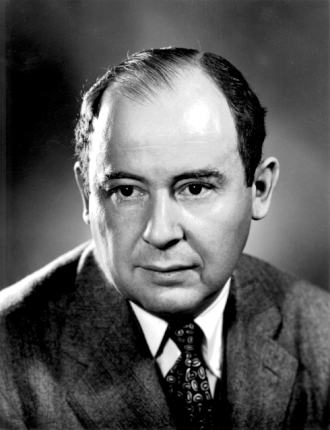 John von Neumann
"Children must be free to think in all directions irrespective of the peculiar ideas of parents who often seal their childrens minds with preconceived prejudices and false concepts of past generations. Unless we are very careful, very careful indeed, and very conscientious, there is still great danger that our children may turn out to be the same kind of people we are."