SHAWORDS

The trouble with Eichmann was precisely that so many were like him, an — Hannah Arendt

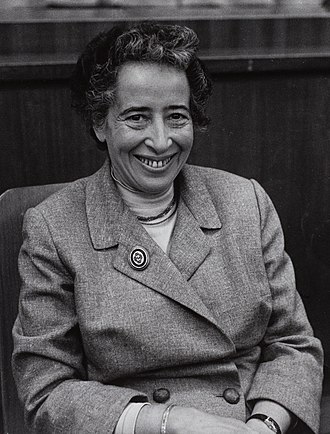
"The trouble with Eichmann was precisely that so many were like him, and that the many were neither perverted nor sadistic, that they were, and still are, terribly and terrifyingly normal. From the viewpoint of our legal institutions and of our moral standards of judgment, this normality was much more terrifying than all the atrocities put together, for it implied — as had been said at Nuremberg over and over again by the defendants and their counsels — that this new type of criminal, who is in actual fact hostis generis humani, commits his crimes under circumstances that make it well-nigh impossible for him to know or to feel that he is doing wrong."
Hannah Arendt
Hannah Arendt
Hannah Arendt
author67 quotes

Hannah Arendt was a German and American historian and philosopher. She was one of the most influential political theorists of the twentieth century.

More by Hannah Arendt

View all →
Quote
"A mixture of gullibility and cynicism had been an outstanding characteristic of mob mentality before it became an everyday phenomenon of masses. In an ever-changing, incomprehensible world the masses had reached the point where they would, at the same time, believe everything and nothing, think that everything is possible and that nothing was true. The mixture in itself was remarkable enough, because it spelled the end of the illusion that gullibility was a weakness of unsuspecting primitive souls and cynicism the vice of superior and refined minds. Mass propaganda discovered that its audience was ready at all times to believe the worst, no matter how absurd, and did not particularly object to being deceived because it held every statement to be a lie anyhow. The totalitarian mass leaders based their propaganda on the correct psychological assumption that, under such conditions, one could make people believe the most fantastic statements one day, and trust that if the next day they were given irrefutable proof of their falsehood, they would take refuge in cynicism; instead of deserting the leaders who had lied to them, they would protest that they had known all along the statement was a lie and would admire the leaders for their superior tactical cleverness."
Hannah ArendtHannah Arendt
Quote
"It is characteristic of the Oxford school of criticism to understand these [metaphysical] fallacies as logical non sequiturs—as though philosophers throughout the centuries had been, for reasons unknown, just a bit too stupid to discover the elementary flaws in their arguments. The truth of the matter is that elementary logical mistakes are quite rare in the history of philosophy; what appear to be errors in logic to minds disencumbered of questions that have been uncritically dismissed as “meaningless” are usually caused by semblances, unavoidable for beings whose whole existence is determined by appearance. Hence, In our context the only relevant question is whether the semblances are inauthentic or authentic ones, whether they are caused by dogmatic beliefs and arbitrary assumptions, mere mirages that disappear upon closer inspection, or whether they are inherent in the paradoxical condition of a living being that, though itself part of the world of appearances, is in possession of a faculty, the ability to think, that permits the mind to withdraw from the world without ever being able to leave it or transcend it."
Hannah ArendtHannah Arendt

More on Sad

View all →
Quote
"The only influences in [the painting The sick Child, Munch painted in his elderly home, remembering very accurate the last days of his dying little sister Sophie] The sick Child.. ..were the ones that come from my home.. ..my childhood and my home. Only someone who knew the conditions at home could possibly understand why there can be no conceivable chance of any other place having played a part – my home is to my art as a midwife is to her children.. ..few painters have ever experienced the full grief of their subject as I did in The sick child. It was not just I who was suffering; it was all my nearest and dearest as well."
Edvard MunchEdvard Munch
Quote
"Im very sad that this seems to be the No. 1 question people want to discuss. I had nothing to do with the issue other than what the media created. I was innocently drawn into the whole controversy. So, after many years, Im glad at least now that I have been given the opportunity to explain to the public and fans my side of the story in my own words. At a lecture, back in 1989, I was asked a question about blasphemy according to Islamic Law, I simply repeated the legal view according to my limited knowledge of the Scriptural texts, based directly on historical commentaries of the Quran. The next day the newspaper headlines read, "Cat Says, Kill Rushdie." I was abhorred, but what could I do? I was a new Muslim. If you ask a Bible student to quote the legal punishment of a person who commits blasphemy in the Bible, he would be dishonest if he didnt mention Leviticus 24:16."
Cat StevensCat Stevens
Quote
"Rhymer, brawler, and musician, Famed for his lunar expedition, And the unnumbered duels he fought, — And lover also, — by interposition! — Here lies Hercule Savinien De Cyrano de Bergerac, Who was everything, yet was naught. I cry you pardon, but I may not stay; See, the moon-ray that comes to call me hence! I would not bid you mourn less faithfully That good, brave Christian: I would only ask That when my body shall be cold in clay You wear those sable mourning weeds for two, And mourn awhile for me, in mourning him."
E
Edmond Rostand