"[A]ll of our environmental problems look like... somebody making a profit for degrading what belongs to the rest of us. ...[T]his behavior should not be allowed within a marketplace. We are fracturing the world. We are liquidating it, we are draining it, we are denuding it, we are over-exploiting it. It is apparent to anyone... The idea that this should not be allowed is transparent."
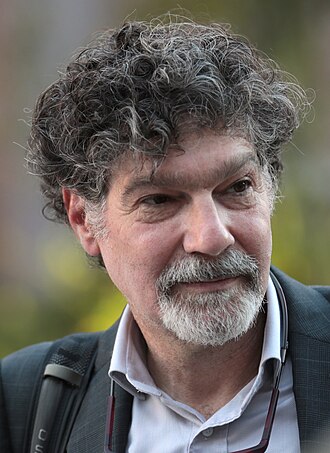
[T]here are two types of systems... One type... the costs of sustainin — Bret Weinstein
"[T]here are two types of systems... One type... the costs of sustaining the system go to the benevolent. That system will inevitably evolve toward ruthlessness and instability. The converse system... where the costs of maintaining the society go to the ruthless evolves towards benevolence and stability. Whenever policy is in question, we should ask ourselves, "Does the policy lead in the direction of the one type or the other."

Bret Samuel Weinstein is an American podcaster, author, and former professor of evolutionary biology. He served on the faculty of Evergreen State College from 2002 until 2017, when he resigned in the aftermath of a series of campus protests about racial equity at Evergreen, which brought Weinstein to national attention. Like his brother Eric Weinstein, he was named as a member of the intellectual
View all quotes by Bret WeinsteinMore by Bret Weinstein
View all →"[My] work... looked at the fact that shortening was being looked at by two different groups... by people interested in counteracting the aging process, and... in exactly the opposite fashion, by people who were interested in tumorigenesis in cancer. ...Tumors ...always had active, thats the enzyme that lengthens our telomeres. So those folks were interested in bringing about a halt in the lengthening of telomeres... to counteract cancer, and the folks that were studying the process were interested in lengthening telomeres... to generate greater repair capacity. ...[M]y point was evolutionarily speaking this looks like a pleiotropic effect, that the genes which create the tendency of the cells to be limited in their capacity to replace themselves, are providing a benefit in youth... that we are largely free of tumors and cancer at the inevitable late life cost that we grow feeble and inefficient, and eventually die. ...[T]hat matches a very old hypothesis in evolutionary theory by somebody I was fortunate enough to know, George Williams..."
"Why is an evolutionary theorist talking about climate change? ...[C]limate change is not really a problem, its more a symptom of a problem... that caused the financial collapse of 2008, that caused the in the Gulf in 2010, and the ongoing Fukushima disaster starting in March of 2011."
"The agents in the market are responding to opportunities that we have left open. It makes no more sense to be angry at them... than it does to be angry at the mosquito for sucking your blood. ...[Y]ou have to close down the opportunity."
"[C]aptive-rodent breeding protocols, designed to increase reproductive output, simultaneously exert strong selection against reproductive senescence and virtually eliminate selection that would otherwise favor tumor suppression. This appears to have greatly elongated the telomeres of laboratory mice. With their telomeric failsafe effectively disabled, these animals are unreliable models of normal senescence and tumor formation. Safety tests employing these animals likely overestimate cancer risks and underestimate tissue damage and consequent accelerated senescence."
"We hypothesize that (1) in vertebrates, a telomeric fail-safe inhibits tumor formation by limiting cellular proliferation. (2) The same system results in the progressive degradation of tissue function with age."