Quote
"Economics deals with the behavior of commodities rather than with the behavior of men."
K
Kenneth Boulding"They, economics and evolution, are both examples of a larger process, which has been at work in this part of the universe for a very long time. This is the process of the development of structures of increasing complexity and improbability. The evolutionary process always operates through mutation and selection and has involved some distinction between the genotype which mutates and the phenotype which is selected. The process by which the genotype constructs the phenotype may be described as "organization". Economic development manifesto itself largely in the production of commodities, that is, goods and services. It originates, however, in ideas, plans, and attitudes in the human mind. These are the genotypes in economic development. This whole process indeed can be described as a process in the growth of knowledge. What the economist calls "capital" is nothing more than human knowledge imposed on the material world. Knowledge and the growth of knowledge, therefore, is the essential key to economic development. Investment, financial systems and economic organizations and institutions are in a sense only the machinery by which a knowledge process is created and expressed."
Kenneth Ewart Boulding was an English-born American economist, educator, peace activist, and interdisciplinary philosopher. Boulding was the author of two citation classics: The Image: Knowledge in Life and Society (1956) and Conflict and Defense: A General Theory (1962). He was co-founder of general systems theory and founder of numerous ongoing intellectual projects in economics and social scien
"Economics deals with the behavior of commodities rather than with the behavior of men."
"Mathematicians themselves set up standards of generality and elegance in their exposition which are a bar to understand."
"The right to have children should be a marketable commodity, bought and traded by individuals but absolutely limited by the state."
"We all, or nearly all, consent If wages rise by ten per cent It puts a choice before the nation Of unemployment or inflation."
"The idea of knowledge as an improbable structure is still a good place to start. Knowledge, however, has a dimension which goes beyond that of mere information or improbability. This is a dimension of significance which is very hard to reduce to quantitative form. Two knowledge structures might be equally improbable but one might be much more significant than the other."
"Canada has no cultural unity, no linguistic unity, no religious unity, no economic unity, no geographic unity. All it has is unity."
"In the life of the mass-order, the culture of the generality tends to conform to the demands of the average human being. Spirituality decays through being diffused among the masses when knowledge is impoverished in every possible way by rationalisation until it becomes accessible to the crude understanding of all."
"I say this to you because we Spaniards are a forgetful people, because we are used to living for the moment, because we do not look back, because we do not know how to see the chain of heroes, because we do not contemplate the sum of sacrifices."
 Francisco Franco
"Sharon Tate was my best friend. Once, we were roommates. She introduced me to my husband. She was the godmother to my baby daughter who is named for her. In the six years time that I knew her, she never said an unkind word about anyone."
"Long time to see. (VS: Tapion)"
"Most mathematicians prove what they can, von Neumann proves what he wants." Once in a discussion about the rapid growth of mathematics in modern times, von Neumann was heard to remark that whereas thirty years ago a mathematician could grasp all of mathematics, that is impossible today. Someone asked him: "What percentage of all mathematics might a person aspire to understand today?" Von Neumann went into one of his five-second thinking trances, and said: "About 28 percent."
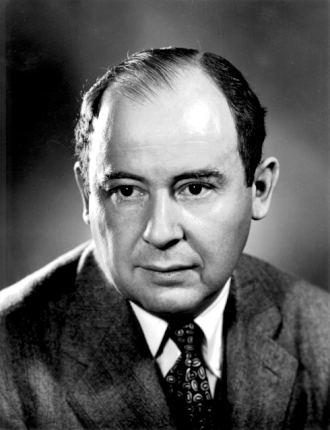 John von Neumann
"Children must be free to think in all directions irrespective of the peculiar ideas of parents who often seal their childrens minds with preconceived prejudices and false concepts of past generations. Unless we are very careful, very careful indeed, and very conscientious, there is still great danger that our children may turn out to be the same kind of people we are."