Quote
"Humility is not thinking less of yourself, its thinking of yourself less."
C
C. S. Lewis"They have an engine called the Press whereby the people are deceived."
Clive Staples Lewis was a British author, literary scholar and Anglican lay theologian. He held academic positions in English literature at both Magdalen College, Oxford (1925–1954), and Magdalene College, Cambridge (1954–1963). He is best known as the author of The Chronicles of Narnia, but he is also noted for his other works of fiction, such as The Screwtape Letters and The Space Trilogy, and f
"Humility is not thinking less of yourself, its thinking of yourself less."
"The devil...the prowde spirit...cannot endure to be mocked."
"Then those people are right who say that Heaven and Hell are only states of mind?" "Hush," he said sternly. "Do not blaspheme. Hell is a state of mind — ye never said a truer word. And every state of mind, left to itself, every shutting up of the creature within the dungeon of its own mind — is, in the end, Hell. But Heaven is not a state of mind. Heaven is reality itself. All that is fully real is Heavenly."
"There is something which unites magic and applied science while separating both from the wisdom of earlier ages. For the wise men of old the cardinal problem had been how to conform the soul to reality, and the solution had been knowledge, self-discipline, and virtue. For magic and applied science alike the problem is how to subdue reality to the wishes of men."
"It comes, it comes! they sang. Sleepers awake! It comes, it comes, it comes. One dreadful glance over my shoulder I essayed — not long enough to see (or did I see?) the rim of the sunrise that shoots Time dead with golden arrows and puts to flight all phantasmal shapes. Screaming, I buried my face in the fold of the Teachers robe. The morning! The morning! I cried. I am caught by the morning and I am a ghost."
"Suppose I think, after doing my accounts, that I have a large balance at the bank. And suppose you want to find out whether this belief of mine is “wishful thinking.” You can never come to any conclusion by examining my psychological condition. Your only chance of finding out is to sit down and work through the sum yourself. When you have checked my figures, then, and then only, will you know whether I have that balance or not. If you find my arithmetic correct, then no amount of vapouring about my psychological condition can be anything but a waste of time. If you find my arithmetic wrong, then it may be relevant to explain psychologically how I came to be so bad at my arithmetic, and the doctrine of the concealed wish will become relevant—but only after you have yourself done the sum and discovered me to be wrong on purely arithmetical grounds. It is the same with all thinking and all systems of thought. If you try to find out which are tainted by speculating about the wishes of the thinkers, you are merely making a fool of yourself. You must first find out on purely logical grounds which of them do, in fact, break down as arguments. Afterwards, if you like, go on and discover the psychological causes of the error."
"I say this to you because we Spaniards are a forgetful people, because we are used to living for the moment, because we do not look back, because we do not know how to see the chain of heroes, because we do not contemplate the sum of sacrifices."
 Francisco Franco
"If it fulfills our hopes, this center will be, at once, a symbol and a reflection and a hope. It will symbolize our belief that the world of creation and thought are at the core of all civilization. Only recently in the White House we helped commemorate the 400th anniversary of Shakespeare. The political conflicts and ambitions of his England are known to the scholar and to the specialist. But his plays will forever move men in every corner of the world. The leaders that he wrote about live far more vividly in his words than in the almost forgotten facts of their own rule. Our civilization, too, will largely survive in the works of our creation. There is a quality in art which speaks across the gulf dividing man from man and nation from nation, and century from century. That quality confirms the faith that our common hopes may be more enduring than our conflicting hostilities. Even now men of affairs are struggling to catch up with the insights of great art. The stakes may well be the survival of civilization. The personal preferences of men in government are not important--except to themselves. However, it is important to know that the opportunity we give to the arts is a measure of the quality of our civilization. It is important to be aware that artistic activity can enrich the life of our people, which really is the central object of Government. It is important that our material prosperity liberate and not confine the creative spirit."
"There was a man and he had eight sons. Apart from that, he was nothing more than a comma on the page of History. Its sad, but thats all you can say about some people."
"Children must be free to think in all directions irrespective of the peculiar ideas of parents who often seal their childrens minds with preconceived prejudices and false concepts of past generations. Unless we are very careful, very careful indeed, and very conscientious, there is still great danger that our children may turn out to be the same kind of people we are."
"I hear people say I swing at bad pitches. What is a bad pitch? If I can hit it, its not a bad pitch."
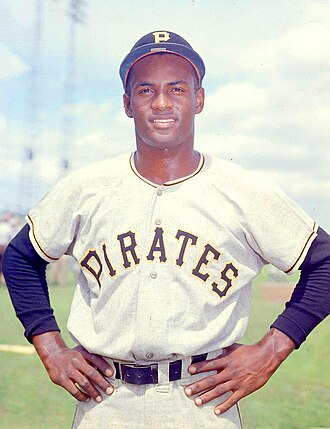 Roberto Clemente
"A free people will always refuse to put up with preventable poverty. If freedom is to be saved and enlarged, poverty must be ended. There is no other solution. The problem of how to prevent these three forces from coming into head-on collision is the principal study of the more politically conscious Conservative leaders. How can wealth persuade poverty to use its political freedom to keep wealth in power? Here lies the whole art of Conservative politics in the twentieth century."