Quote
"Dangers await only those who do not react to life."
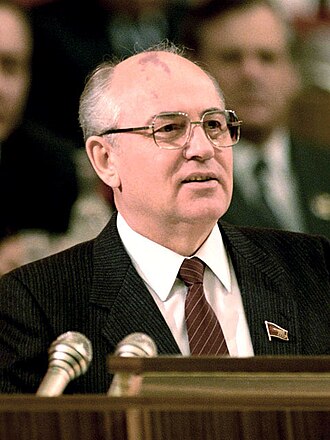 Mikhail Gorbachev
"Thus within three years the former Andropov protege had totally transformed Soviet foreign policy, replacing its messianic Marxist creed with a radical internationalism. Among the strongest reactions was the New York Times, whose December 8 editorial stated: "Perhaps not since Woodrow Wilson presented his Fourteen Points in 1918 or since Franklin Roosevelt has a world figure demonstrated the vision Mikhail Gorbachev displayed yesterday at the United Nations." A number of scholars believe that the Cold War ended in December 1988 with neither a winner nor a loser. According to this view, one of the Superpowers simply called off the ideological rivalry that had begun in 1917, withdrew from the post-1945 arms race, and relinquished control over regimes dependent on Soviet force and economic subsidies for their survival. Although not everyone agrees, it is certainly reasonable to assert that without Gorbachevs bold international agenda the world may well have remained divided into two armed camps, and the events that followed would have had entirely different outcomes."
Mikhail Sergeyevich Gorbachev was a Soviet and Russian politician who was the last leader of the Soviet Union from 1985 until the country's dissolution in 1991. He served as General Secretary of the Communist Party from 1985, and additionally as head of state from 1988. Ideologically, he initially adhered to Marxism–Leninism, but moved towards social democracy by the early 1990s.
Mikhail Sergeyevich Gorbachev was a Soviet and Russian politician who was the last leader of the Soviet Union from 1985 until the country's dissolution in 1991. He served as General Secretary of the Communist Party from 1985, and additionally as head of state from 1988. Ideologically, he initially adhered to Marxism–Leninism, but moved towards social democracy by the early 1990s.
View all quotes by Mikhail Gorbachev"Dangers await only those who do not react to life."
Mikhail Gorbachev"If what you have done yesterday still looks big to you, you havent done much today."
Mikhail Gorbachev"Gorbachevs political views were more audacious. Unlike Deng Xiaoping, who, after the chaos of the Cultural Revolution, was obsessed with stability and ruled out democratic reforms, Gorbachev linked perestroika with a policy of glasnost (openness). Taking aim at the USSRs encrusted ruling party and bureaucracy, Gorbachev adopted a stillborn project of Andropovs to reduce their power by introducing new- even Western- ideas into the Soviet environment and engaging the Soviet population in modernizing the country. He went so far as to authorize the opening of the records of Soviet history, including its darkest moments, which ignited an explosion of criticism reaching back to Lenins rule. To be sure, Gorbachevs purpose was to preserve the communist system by revitalizing it from above, but by combining perestroika with glasnost the Soviet leader risked unleashing forces he was ultimately unable to control. Gorbachev was even more daring in his foreign policy because he believed that the relaxation of international tensions was indispensable to his political reforms at home. Convinced that the Soviet Unions greatest threat was nuclear war but that its huge military budget was unsupportable, he intended to achieve security by scaling down the global rivalry between Moscow and Washington and reviving détente. After assembling a group of like-minded liberal internationalists, among them the new foreign minister, Eduard Shevardnadze, and his foreign policy adviser, Anatoly Chernyaev, Gorbachev boldly embarked on a step-by-step program of reducing the USSRs isolation and reaching out to the other side, which included Western Europe, Japan, and China as well as the United States."
Mikhail Gorbachev"Few Soviet citizens lamented Gorbachëv’s going. His policies had ruined the economy and smashed the state into fragments. His critics showed him no mercy. This was ungenerous of them since without his introduction of glasnost and perestroika they could never have had the opportunity to calumniate him. Abroad, he was better respected. His disinclination to halt the decommunisation of eastern Europe by force was widely admired. His primary role in the ending of the Cold War was rightly esteemed. There had been many times when a different General Secretary would have called upon the armed forces and the KGB and reversed the reform programme. Yet the verdict on him has to take account of his inability to understand the nature of the Soviet order. He had genuinely believed that the USSR could be reformed and still remain communist. He had a passion for a democratic, humanitarian Lenin who had never existed in history."
Mikhail Gorbachev"President Gorbachev’s achievements were truly great and historic. Not only did he dissolve the Soviet Union more or less peacefully, but he also prevented a major civil war that could have escalated into a nuclear conflict. I sincerely hope that historians in the future will honor the major achievements and statesmanship of President Gorbachev and of the other leading Soviet politicians of that time."
Mikhail Gorbachev"I consider it vitally important to preserve the democratic achievements which have been attained in the last few years. We have paid with all our history and tragic experience for these democratic achievements, and they are not to be abandoned, whatever the circumstances, and whatever the pretexts. Otherwise, all our hopes for the best will be buried."
Mikhail Gorbachev"In the life of the mass-order, the culture of the generality tends to conform to the demands of the average human being. Spirituality decays through being diffused among the masses when knowledge is impoverished in every possible way by rationalisation until it becomes accessible to the crude understanding of all."
"I say this to you because we Spaniards are a forgetful people, because we are used to living for the moment, because we do not look back, because we do not know how to see the chain of heroes, because we do not contemplate the sum of sacrifices."
 Francisco Franco
"Sharon Tate was my best friend. Once, we were roommates. She introduced me to my husband. She was the godmother to my baby daughter who is named for her. In the six years time that I knew her, she never said an unkind word about anyone."
"Long time to see. (VS: Tapion)"
"Most mathematicians prove what they can, von Neumann proves what he wants." Once in a discussion about the rapid growth of mathematics in modern times, von Neumann was heard to remark that whereas thirty years ago a mathematician could grasp all of mathematics, that is impossible today. Someone asked him: "What percentage of all mathematics might a person aspire to understand today?" Von Neumann went into one of his five-second thinking trances, and said: "About 28 percent."
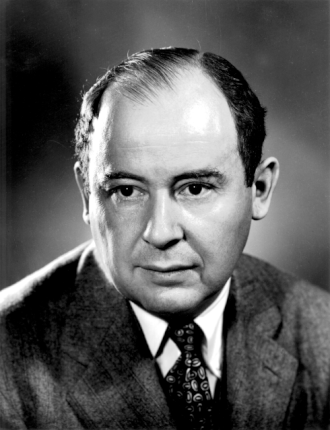 John von Neumann
"Children must be free to think in all directions irrespective of the peculiar ideas of parents who often seal their childrens minds with preconceived prejudices and false concepts of past generations. Unless we are very careful, very careful indeed, and very conscientious, there is still great danger that our children may turn out to be the same kind of people we are."