Quote
"But the mighty computer is stupid. Thinking with the speed of light but unable to cross the gaps of intuition."
R
Robert Silverberg"To opt for being a tourist is to choose the easiest but most contemptible path; ultimately it’s the most dangerous one, too, in a certain sense. You have to accept the built-in epithets that go with the part: they will think of you as a foolish tourist, an ignorant tourist, a vulgar tourist, a mere tourist. Do you want to be considered mere? Around you able to accept that? Is that really your preferred self-image—baffled, bewildered, led about by the nose? Youll sign up for packaged tours, youll carry guidebooks and cameras, youll go to the cathedral and the museums and the marketplace, and youll remain always on the outside of things, seeing a great deal, experiencing nothing. What a waste! You will be diminished by the very traveling that you thought would expand you. Tourism hollows and parches you. All places become one: a hotel, a smiling, swarthy, sunglassed guide, a bus, a plaza, a fountain, a marketplace, a museum, a cathedral. You are transformed into a feeble shriveled thing made out of glued-together travel folders; you are naked but for your visas; the sum of your life’s adventures is a box of leftover small change from many indistinguishable lands."
Robert Silverberg is a prolific American science fiction author and editor. He is a multiple winner of both Hugo and Nebula Awards, a member of the Science Fiction and Fantasy Hall of Fame, and a Grand Master of SF since 2004.
Robert Silverberg is a prolific American science fiction author and editor. He is a multiple winner of both Hugo and Nebula Awards, a member of the Science Fiction and Fantasy Hall of Fame, and a Grand Master of SF since 2004.
View all quotes by Robert Silverberg"But the mighty computer is stupid. Thinking with the speed of light but unable to cross the gaps of intuition."
"Stale is stale and borrowed is borrowed, no matter how original your models may have been."
"It did not seem at all improbable to McCulloch now. The infinite fullness of time brings about everything, he thought: even intelligent lobsters, even a divine octopus."
"Not all lawyers are annoying. Some are dead."
"A man who lies to himself is the worst liar of all."
"Ignorance can’t be pardoned. Only cured."
"In the life of the mass-order, the culture of the generality tends to conform to the demands of the average human being. Spirituality decays through being diffused among the masses when knowledge is impoverished in every possible way by rationalisation until it becomes accessible to the crude understanding of all."
"The first thing I remember about the world — and I pray that it may be the last — is that I was a stranger in it. This feeling, which everyone has in some degree, and which is, at once, the glory and desolation of homo sapiens, provides the only thread of consistency that I can detect in my life."
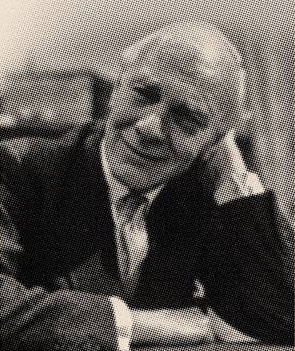 Malcolm Muggeridge
"Jewish custom, which traces descent solely from the mother, is more sensible and more discreet. Our own lawgivers cant accept the fact that there are many things in family life that are best kept shrouded in mystery."
"One makes mistakes; that is life. But it is never a mistake to have loved."
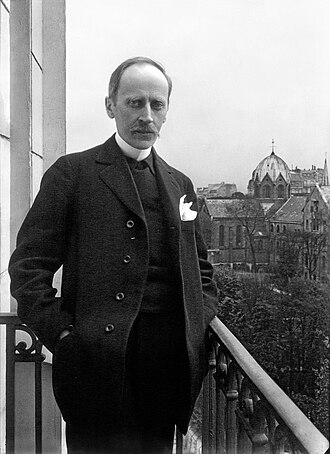 Romain Rolland
"If it fulfills our hopes, this center will be, at once, a symbol and a reflection and a hope. It will symbolize our belief that the world of creation and thought are at the core of all civilization. Only recently in the White House we helped commemorate the 400th anniversary of Shakespeare. The political conflicts and ambitions of his England are known to the scholar and to the specialist. But his plays will forever move men in every corner of the world. The leaders that he wrote about live far more vividly in his words than in the almost forgotten facts of their own rule. Our civilization, too, will largely survive in the works of our creation. There is a quality in art which speaks across the gulf dividing man from man and nation from nation, and century from century. That quality confirms the faith that our common hopes may be more enduring than our conflicting hostilities. Even now men of affairs are struggling to catch up with the insights of great art. The stakes may well be the survival of civilization. The personal preferences of men in government are not important--except to themselves. However, it is important to know that the opportunity we give to the arts is a measure of the quality of our civilization. It is important to be aware that artistic activity can enrich the life of our people, which really is the central object of Government. It is important that our material prosperity liberate and not confine the creative spirit."
"I did not go to join Kurtz there and then. I did not. I remained to dream the nightmare out to the end, and to show my loyalty to Kurtz once more. Destiny. My destiny! Droll thing life is — that mysterious arrangement of merciless logic for a futile purpose. The most you can hope from it is some knowledge of yourself — that comes too late — a crop of unextinguishable regrets. I have wrestled with death. It is the most unexciting contest you can imagine. It takes place in an impalpable grayness, with nothing underfoot, with nothing around, without spectators, without clamor, without glory, without the great desire of victory, without the great fear of defeat, in a sickly atmosphere of tepid skepticism, without much belief in your own right, and still less in that of your adversary. If such is the form of ultimate wisdom, then life is a greater riddle than some of us think it to be. I was within a hairs-breadth of the last opportunity for pronouncement, and I found with humiliation that probably I would have nothing to say. This is the reason why I affirm that Kurtz was a remarkable man. He had something to say. He said it. Since I had peeped over the edge myself, I understand better the meaning of his stare, that could not see the flame of the candle, but was wide enough to embrace the whole universe, piercing enough to penetrate all the hearts that beat in the darkness. He had summed up — he had judged. The horror! He was a remarkable man. After all, this was the expression of some sort of belief; it had candor, it had conviction, it had a vibrating note of revolt in its whisper, it had the appalling face of a glimpsed truth — the strange commingling of desire and hate."