Quote
"The people made the Constitution, and the people can unmake it. It is the creature of their own will, and lives only by their will."
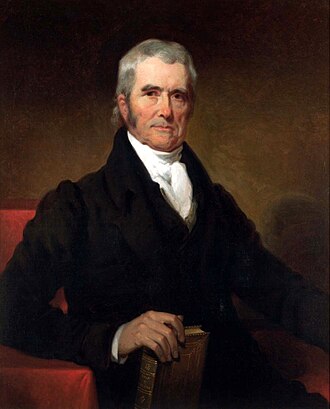 John Marshall
"We have no more right to decline the exercise of jurisdiction which is given, than to usurp that which is not given. The one or the other would be treason to the constitution."
John Marshall was an American statesman, jurist, and Founding Father who served as the fourth chief justice of the United States from 1801 until his death in 1835. He remains the longest-serving chief justice and fifth-longest-serving justice in the history of the U.S. Supreme Court, and he is widely regarded as one of the most influential justices ever to serve. Prior to joining the court, Marsha
"The people made the Constitution, and the people can unmake it. It is the creature of their own will, and lives only by their will."
John Marshall"[T]he constitution controls any legislative act repugnant to it. … It is emphatically the province and duty of the Judicial Department to say what the law is. Those who apply the rule to particular cases must, of necessity, expound and interpret that rule. If two laws conflict with each other, the Courts must decide on the operation of each. So, if a law be in opposition to the Constitution, if both the law and the Constitution apply to a particular case, so that the Court must either decide that case conformably to the law, disregarding the Constitution, or conformably to the Constitution, disregarding the law, the Court must determine which of these conflicting rules governs the case. This is of the very essence of judicial duty. If, then, the Courts are to regard the Constitution, and the Constitution is superior to any ordinary act of the Legislature, the Constitution, and not such ordinary act, must govern the case to which they both apply. … Those then who controvert the principle that the constitution is to be considered, in court, as a paramount law, are reduced to the necessity of maintaining that courts must close their eyes on the constitution, and see only the law. This doctrine would subvert the very foundation of all written constitutions … It would be giving the legislature a practical and real omnipotence … The judicial power of the United States is extended to all cases arising under the constitution."
John Marshall"Whether a law be void for its repugnancy to the Constitution, is, at all times, a question of much delicacy, which out seldom, if ever, to be decided in the affirmative, in doubtful case. … But it is not on slight implication and vague conjecture that the legislature is to be pronounced to have transcended its powers, and its acts to be considered as void. The opposition between the Constitution and the law should be such that the judge feels a clear and strong conviction of their incompatibility with each other."
John Marshall"Courts are the mere instruments of the law, and can will nothing. When they are said to exercise a discretion, it is a mere legal discretion, a discretion to be exercised in discerning the course prescribed by law; and, when that is discerned, it is the duty of the Court to follow it. Judicial power is never exericised for the purpose of giving effect to the will of the Judge; always for the purpose of giving effect to the will of the Legislature; or, in other words, to the will of the law."
John Marshall"The subject is the execution of those great powers on which the welfare of a Nation essentially depends. It must have been the intention of those who gave these powers, to insure, as far as human prudence could insure, their beneficial execution. This could not be done by confiding the choice of means to such narrow limits as not to leave it in the power of Congress to adopt any which might be appropriate, and which were conducive to the end. This provision is made in a constitution intended to endure for ages to come, and, consequently, to be adapted to the various crises of human affairs."
John Marshall"We must never forget that it is a constitution we are expounding."
John Marshall