Quote
"Notre raison est toujours déçue par linconstance des apparences."
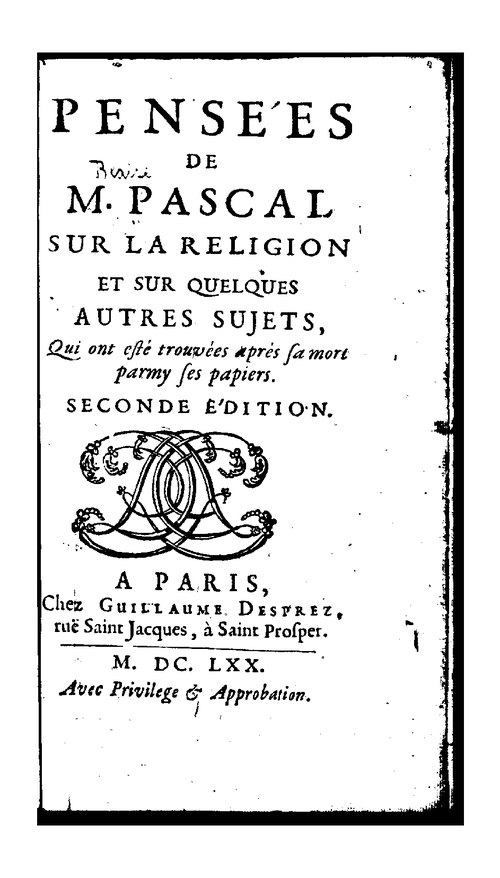 Pensées
"We know truth, not only by the reason, but also by the heart, and it is in this last way that we know first principles; and reason, which has no part in it, tries in vain to impugn them. The sceptics, who have only this for their object, labour to no purpose. We know that we do not dream, and however impossible it is for us to prove it by reason, this inability demonstrates only the weakness of our reason, but not, as they affirm, the uncertainty of all our knowledge. For the knowledge of first principles, as space, time, motion, number, is as sure as any of those which we get from reasoning. And reason must trust these intuitions of the heart, and must base them on every argument. (We have intuitive knowledge of the tri-dimensional nature of space, and of the infinity of number, and reason then shows that there are no two square numbers one of which is double of the other. Principles are intuited, propositions are inferred, all with certainty, though in different ways.) And it is as useless and absurd for reason to demand from the heart proofs of her first principles, before admitting them, as it would be for the heart to demand from reason an intuition of all demonstrated propositions before accepting them. This inability ought, then, to serve only to humble reason, which would judge all, but not to impugn our certainty, as if only reason were capable of instructing us. Would to God, on the contrary, that we had never need of it, and that we knew everything by instinct and intuition! But nature has refused us this boon. On the contrary, she has given us but very little knowledge of this kind; and all the rest can be acquired only by reasoning. Therefore, those to whom God has imparted religion by intuition are very fortunate, and justly convinced. But to those who do not have it, we can give it only by reasoning, waiting for God to give them spiritual insight, without which faith is only human, and useless for salvation."
The Pensées (Thoughts) is a collection of fragments written by the French 17th-century philosopher and mathematician Blaise Pascal. Pascal's religious conversion led him into a life of asceticism, and the Pensées was in many ways his life's work. It represented Pascal's defense of the Christian religion, and the concept of "Pascal's wager" stems from a portion of this work.
"Notre raison est toujours déçue par linconstance des apparences."
Pensées"There are then two kinds of intellect: the one able to penetrate acutely and deeply into the conclusions of given premises, and this is the precise intellect; the other able to comprehend a great number of premises without confusing them, and this is the mathematical intellect. The one has force and exactness, the other comprehension. Now the one quality can exist without the other; the intellect can be strong and narrow, and can also be comprehensive and weak."
Pensées"Those who are accustomed to judge by feeling do not understand the process of reasoning, for they would understand at first sight, and are not used to seek for principles. And others, on the contrary, who are accustomed to reason from principles, do not at all understand matters of feeling, seeking principles, and being unable to see at a glance."
Pensées"La vraie éloquence se moque de léloquence, la vraie morale se moque de la morale."
Pensées"...it is to judgment that perception belongs, as science belongs to intellect. Intuition is the part of judgment, mathematics of intellect."
Pensées"Man loves malice, but not against one-eyed men nor the unfortunate, but against the fortunate and proud."
Pensées