SHAWORDS

Whatever sphere we may be in, there is a profound joy in the realizati — Rollo May

HomeRollo MayQuote
"Whatever sphere we may be in, there is a profound joy in the realization that we are helping to form the structure of the new world. This is creative courage, however minor or fortuitous our creations may be. We can then say, with Joyce, Welcome, O life! We go for the millionth time to forge in the smithy of our souls the uncreated conscience of the race."
R
Rollo May
Rollo May
author112 quotes

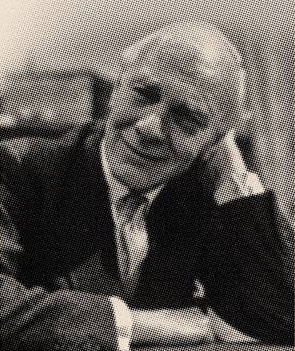
Rollo Reece May was an American existential psychologist and author of the influential book Love and Will (1969). He is often associated with humanistic psychology and existentialist philosophy, and alongside Viktor Frankl, was a major proponent of existential psychotherapy. The philosopher and theologian Paul Tillich was a close friend who had a significant influence on his work.

More by Rollo May

View all →
Quote
"My fellow liberals and I in America, and in Europe to a lesser extent, believed so strongly in peace and world brotherhood in those days that we could not even see Hitler or the destructively daimonic reality he represented. Human beings just couldnt be that cruel in the our civilized twentieth century — the accounts in the papers must be wrong. Our error was that we let our convictions limit our perceptions. We had no place for the daimonic; we believed that the world must somehow fit our convictions, and the whole daimonic dimension was ruled out of our perception. Not to recognize the daimonic itself turns out to be daimonic, it makes us accomplices on the side of the destructive possession. The denial of the daimonic is, in effect, a self-castration in love and a self-nullification in will. And the denial leads to the perverted forms of aggression we have seen in our day in which the repressed comes back to haunt us."
R
Rollo May
Quote
"In any age courage is the simple virtue needed for a human being to traverse the rocky road from infancy to maturity of personality. But in an age of anxiety, an age of her morality and personal isolation, courage is a sine qua non. In periods when the mores of the society were more consistent guides, the individual was more firmly cushioned in his crises of development; but in times of transition like ours, the individual is thrown on his own at an earlier age and for a longer period."
R
Rollo May
Quote
"I must make the important distinction between the rebel and the revolutionary. One is in ineradicable opposition to the other. The revolutionary seeks an external political change, "the overthrow or renunciation of one government or ruler and the substitution of another." The origin of the term is the word revolve, literally meaning a turnover, as the revolution of a wheel. When the conditions under a given government are insufferable some groups may seek to break down that government in the conviction that any new form cannot but be better. Many revolutions, however, simply substitute one kind of government for another, the second no better than the first — which leaves the individual citizen, who has had to endure the inevitable anarchy between the two, worse off than before. Revolution may do more harm than good. The rebel, on the other hand, is "one who opposes authority or restraint: one who breaks with established custom or tradition." … He seeks above all an internal change, a change in the attitudes, emotions, and outlook of the people to whom he is devoted. He often seems to be temperamentally unable to accept success and the ease it brings; he kicks against the pricks, and when one frontier is conquered, he soon becomes ill-at-ease and pushes on to the new frontier. He is drawn to the unquiet minds and spirits, for he shares their everlasting inability to accept stultifying control. He may, as Socrates did, refer to himself as the gadfly for the state — the one who keeps the state from settling down into a complacency, which is the first step toward decadance. No matter how much the rebel gives the appearance of being egocentric or of being on an "ego trip," this is a delusion; inwardly the authentic rebel is anything but brash."
R
Rollo May

More on Life

View all →
Quote
"If it fulfills our hopes, this center will be, at once, a symbol and a reflection and a hope. It will symbolize our belief that the world of creation and thought are at the core of all civilization. Only recently in the White House we helped commemorate the 400th anniversary of Shakespeare. The political conflicts and ambitions of his England are known to the scholar and to the specialist. But his plays will forever move men in every corner of the world. The leaders that he wrote about live far more vividly in his words than in the almost forgotten facts of their own rule. Our civilization, too, will largely survive in the works of our creation. There is a quality in art which speaks across the gulf dividing man from man and nation from nation, and century from century. That quality confirms the faith that our common hopes may be more enduring than our conflicting hostilities. Even now men of affairs are struggling to catch up with the insights of great art. The stakes may well be the survival of civilization. The personal preferences of men in government are not important--except to themselves. However, it is important to know that the opportunity we give to the arts is a measure of the quality of our civilization. It is important to be aware that artistic activity can enrich the life of our people, which really is the central object of Government. It is important that our material prosperity liberate and not confine the creative spirit."
L
Lyndon B. Johnson
Quote
"I did not go to join Kurtz there and then. I did not. I remained to dream the nightmare out to the end, and to show my loyalty to Kurtz once more. Destiny. My destiny! Droll thing life is — that mysterious arrangement of merciless logic for a futile purpose. The most you can hope from it is some knowledge of yourself — that comes too late — a crop of unextinguishable regrets. I have wrestled with death. It is the most unexciting contest you can imagine. It takes place in an impalpable grayness, with nothing underfoot, with nothing around, without spectators, without clamor, without glory, without the great desire of victory, without the great fear of defeat, in a sickly atmosphere of tepid skepticism, without much belief in your own right, and still less in that of your adversary. If such is the form of ultimate wisdom, then life is a greater riddle than some of us think it to be. I was within a hairs-breadth of the last opportunity for pronouncement, and I found with humiliation that probably I would have nothing to say. This is the reason why I affirm that Kurtz was a remarkable man. He had something to say. He said it. Since I had peeped over the edge myself, I understand better the meaning of his stare, that could not see the flame of the candle, but was wide enough to embrace the whole universe, piercing enough to penetrate all the hearts that beat in the darkness. He had summed up — he had judged. The horror! He was a remarkable man. After all, this was the expression of some sort of belief; it had candor, it had conviction, it had a vibrating note of revolt in its whisper, it had the appalling face of a glimpsed truth — the strange commingling of desire and hate."
H
Heart of Darkness