Quote
"India contains the whole history of philosophy in a nutshell."
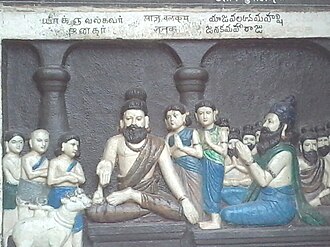 Indian philosophy
"When I was a student, the term "Indian philosophy: was usually regarded as self-contradictory, a contradictio in adjecto, comparable to such an absurdity as "wooden steel." "Indian philosophy" was something that simply did not exist."
Indian philosophy consists of philosophical traditions of the Indian subcontinent The philosophies are often called darśana, meaning "to see" or "looking at" Aanviksiki means “critical inquiry” or “investigation" Unlike darśana, aanviksiki was used to refer to Indian philosophies by classical Indian philosophers, such as Chanakya in the Arthaśaastra
"India contains the whole history of philosophy in a nutshell."
Indian philosophy"Mathematical science was so perfect and astronomical observations so complete that the paths of the sun and the moon were accurately measured. The philosophy of the learned few was perhaps for the first time, firmly allied with the theology of the believing many, and Brahmanism laid down as articles of faith the unity of God, the creation of the world, the immortality of the soul, and the responsibility of man. The remote dwellers upon the Ganges distinctly made known that future life about which Moses is silent or obscure, and that unity and Omnipotence of the Creator which were unknown to the polytheism of the Greek and Roman multitude, and to the dualism of Mithraic legislators, while Vyasa perhaps surpassed Plato in keeping the people tremblingly alive to the punishment which awaited evil deeds."
Indian philosophy"After these conversations with Tagore some of the ideas that had seemed so crazy suddenly made much more sense. That was a great help for me."
Indian philosophy"Even Plato seems to me to be in all main points only a Brahmin’s good pupil."
Indian philosophy"The greatest human ideal is the great cause of bringing together the thoughts of Europe and Asia; the great soul of India will topple our world."
Indian philosophy"Two years spent in the study of Sanskrit under Charles Lanman, and a year in the mazes of Patanjalis metaphysics under the guidance of James Woods, left me in a state of enlightened mystification. A good half of the effort of understanding what the Indian philosophers were after--and their subtleties make most of the great European philosophers look like schoolboys--lay in trying to erase from my mind all the categories and kinds of distinction common to European philosophy from the time of the Greeks. My previous and concomitant study of European philosophy was hardly better than an obstacle. And I came to the conclusion--seeing also that the "influence" of Brahmin and Buddhist thought upon Europe, as in Schopenhauer, Hartmann, and Deussen, had largely been through romantic misunderstanding--that my only hope of really penetrating to the heart of that mystery would lie in forgetting how to think and feel as an American or a European: which, for practical as well as sentimental reasons, I did not wish to do."
Indian philosophy