SHAWORDS

Why should you read a book on economic growth? Because the subject is — Ibn Khaldun

HomeIbn KhaldunQuote
"Why should you read a book on economic growth? Because the subject is important: it is about the well-being of our societies today and in the future; and because it is beautiful. It carries wonderful ideas, some exposed more than 2000 years ago, spanning all civilizations. You will certainly marvel at Ibn Khaldun’s prescience, at Mo Tzu’s wisdom, at Solow’s depiction of transition phases, at Dorfman’s incredible intuition in solving variational problems."
Why should you read a book on economic growth? Because the subject is important: it is about the well-being of our socie
Ibn Khaldun
Ibn Khaldun
Ibn Khaldun
author20 quotes

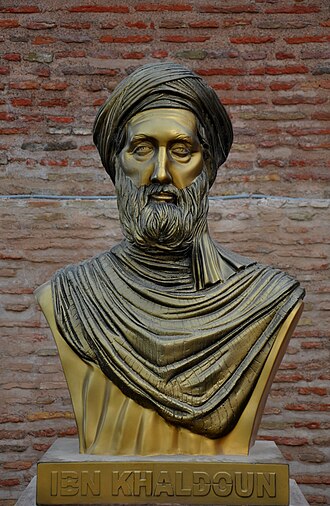
Ibn Khaldun was an Arab scholar, historian, philosopher, and sociologist. He is widely acknowledged to be one of the greatest social scientists of the Middle Ages, and is considered by a number of scholars to be a major forerunner of historiography, sociology, economics, and demography studies.

About Ibn Khaldun

Ibn Khaldun was an Arab scholar, historian, philosopher, and sociologist. He is widely acknowledged to be one of the greatest social scientists of the Middle Ages, and is considered by a number of scholars to be a major forerunner of historiography, sociology, economics, and demography studies.

View all quotes by Ibn Khaldun

More by Ibn Khaldun

View all →
Quote
"Their qualities of character, moreover, are close to those of dumb animals. It has ever been reported that most of the Negroes of the first [climatic] zone dwell in caves and thickets, eat herbs, live in savage isolation and do not congregate, and eat each other. The same applies to the Slavs. The reason for this is that their remoteness from being temperate produces in them a disposition and character similar to those of the dumb animals, and they become correspondingly remote from humanity."
Ibn KhaldunIbn Khaldun
Quote
"(Unlike Muslims), the other religious groups did not have a universal mission, and the holy war was not a religious duty to them, save only for purposes of defence... They are merely required to establish their religion among their own people. This is why the Israelites after Moses and Joshua remained unconcerned with royal authority for about four hundred years. Their only concern was to establish their religion... The Israelites dispossessed the Canaanites of the land that God had given them as their heritage in Jerusalem and the surrounding region, as it had been explained to them through Moses. The nations of the Philistines, the Canaanites, the Armenians, the Edomites, the Ammonites, and the Moabites fought against them. During that time political leadership was entrusted to the elders among them. The Israelites remained in that condition for about four hundred years. They did not have any royal power and were harassed by attacks from foreign nations. Therefore, they asked God through Samuel, one of their prophets, that he permit them to make someone king over them. Thus, Saul became their king. He defeated the foreign nations and killed Goliath, the ruler of Philistines. After Saul, w:David became king, and then Solomon. His kingdom flourished and extended to the borders of the land of the Hijaz and further to the borders of Yemen and to the borders of the land of the Byzantines. After Solomon, the tribes split into two dynasties. One of the dysnaties was that of the ten tribes in the region of Nablus, the capital of which is Samaria(Sabastiyah), and the other that of the children of Judah and Benjamin in Jerusalem. Their royal authority had had an uninterrupted duration of a thousand years."
Ibn KhaldunIbn Khaldun
Quote
"Religious propaganda gives a dynasty at its beginning another power in addition to that of the group feeling it possessed as the result of the number of its supporters... This happened to the Arabs at the beginning of Islam during the Muslim conquests. The armies of the Muslims at al-Qadisiyah and at the Yarmuk numbered some 30,000 in each case, while the Persian troops at al-Qadisiyah numbered 120,000, and the troops of Heraclius, according to al-Waqidi, 400,000. Neither of the two parties was able to withstand the Arabs, who routed them and seized what they possessed."
Ibn KhaldunIbn Khaldun
Quote
"On account of their savage nature, the Bedouins are people who plunder and cause damage. They plunder whatever they are able to lay their hands on without having to fight or to expose themselves to danger. They then retreat to their pastures in the desert. They do not attack or fight except in self-defence. Every stronghold or (locality) that seems difficult to attack, they by-pass in favour of some less difficult (enterprise). Tribes that are protected by inaccessible mountains are safe from their mischief and destructiveness. The Bedouins would not cross hills or undergo hardship and danger in order to get to them. Flat territory, on the other hand, falls victim to their looting and prey to their appetite whenever they (have the opportunity of) gaining power over it. Then they raid, plunder, and attack that territory repeatedly, because it is easily (accessible) to them. Eventually, its inhabitants succumb utterly to the Bedouins and then are pushed around by them in accordance with changes of control and shifts in leadership. Eventually, their civilization is wiped out. God has power over His creatures."
Ibn KhaldunIbn Khaldun
Quote
"Thus, the founders of grammar were Sîbawayh and, after him, al-Fârisî and Az-Zajjâj All of them were of non-Arab (Persian) descent They were brought up in the Arabic language and acquired the knowledge of it through their upbringing and through contact with Arabs They invented the rules of (grammar) and made it into a discipline (in its own right) for later (generations to use) Most of the hadîth scholars who preserved traditions for the Muslims also were Persians, or Persian in language and upbringing, because the discipline was widely cultivated in the Irâq and the regions beyond Furthermore all the scholars who worked in the science of the principles of jurisprudence were Persians The same applies to speculative theologians and to most Qurân commentators Only the Persians engaged in the task of preserving knowledge and writing systematic scholarly works Thus, the truth of the following statement by the Prophet becomes apparent: If scholarship hung suspended in the highest parts of heaven, the Persians would attain it"
Ibn KhaldunIbn Khaldun

More on Wisdom

View all →
Quote
"I did not go to join Kurtz there and then. I did not. I remained to dream the nightmare out to the end, and to show my loyalty to Kurtz once more. Destiny. My destiny! Droll thing life is — that mysterious arrangement of merciless logic for a futile purpose. The most you can hope from it is some knowledge of yourself — that comes too late — a crop of unextinguishable regrets. I have wrestled with death. It is the most unexciting contest you can imagine. It takes place in an impalpable grayness, with nothing underfoot, with nothing around, without spectators, without clamor, without glory, without the great desire of victory, without the great fear of defeat, in a sickly atmosphere of tepid skepticism, without much belief in your own right, and still less in that of your adversary. If such is the form of ultimate wisdom, then life is a greater riddle than some of us think it to be. I was within a hairs-breadth of the last opportunity for pronouncement, and I found with humiliation that probably I would have nothing to say. This is the reason why I affirm that Kurtz was a remarkable man. He had something to say. He said it. Since I had peeped over the edge myself, I understand better the meaning of his stare, that could not see the flame of the candle, but was wide enough to embrace the whole universe, piercing enough to penetrate all the hearts that beat in the darkness. He had summed up — he had judged. The horror! He was a remarkable man. After all, this was the expression of some sort of belief; it had candor, it had conviction, it had a vibrating note of revolt in its whisper, it had the appalling face of a glimpsed truth — the strange commingling of desire and hate."
H
Heart of Darkness
Quote
"My specific... object has been to contain, within the prescribed limits, the whole of the students course, from the confines of elementary algebra and trigonometry, to the entrance of the highest works on mathematical physics. A learner who has a good knowledge of the subjects just named, and who can master the present treatise, taking up elementary works on conic sections, application of algebra to geometry, and the theory of equations, as he wants them, will, I am perfectly sure, find himself able to conquer the difficulties of anything he may meet with; and need not close any book of Laplace, Lagrange, Legendre, Poisson, Fourier, Cauchy, Gauss, Abel, Hindenburgh and his followers. or of any one of our English mathematicians, under the idea that it is too hard for him."
A
Augustus De Morgan