SHAWORDS

You dont become a saint until you lead a good life whether in Tibet or — Kenneth Rexroth

"You dont become a saint until you lead a good life whether in Tibet or Italy or America."
K
Kenneth Rexroth
Kenneth Rexroth
author48 quotes

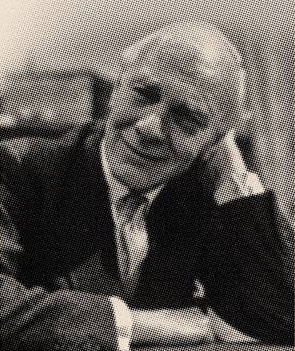
Kenneth Charles Marion Rexroth was an American poet, translator, and critical essayist. He is regarded as a central figure in the San Francisco Renaissance, and paved the groundwork for the movement. Although he did not consider himself to be a Beat poet, and disliked the association, he was dubbed the "Father of the Beats" by Time magazine. Largely self-educated, Rexroth learned several languages

More by Kenneth Rexroth

View all →
Quote
"No one was required to believe in the gods as Christians believe in their creeds. Socrates had always been scrupulous in observance of every accepted principle and practice of community life. However, from his questioning he had developed a civic and personal morality founded on reason rather than custom. He envisioned it as subject to continuous criticism and revaluation in terms of the ever-expanding freedom of morally autonomous but cooperating persons, who together made up a community whose characteristic aim was an organically growing depth, breadth, intensity of experience — experience finally of that ultimate reality characterized by Socrates as good, true and beautiful. The accusers were right. This is a new religion which bears scant resemblance to the old. Civic piety is founded on the recognition of ignorance and the nurture of the soil until it becomes capable of true knowledge — which is a state of being, a moral condition called freedom. The Greek city-state, not to speak of the tribal community, knew nothing of freedom in this sense, but only the liberty that distinguished the free man from the slave."
K
Kenneth Rexroth
Quote
"The contemporary world is being pulled apart by two contrary tendencies — one toward social death, one toward the birth of a new society. Many of the phenomena of the present crisis are ambivalent and can either mean death or birth depending on how the crisis is resolved. The crisis of a civilization is a mass phenomenon and moves onward without benefit of ideology. The demand for freedom, community, life significance, the attack on alienation, is largely inchoate and instinctive. In the libertarian revolutionary movement these objectives were ideological, confined to books, or realized with difficulty, usually only temporarily in small experimental communities, or in individual lives and tiny social circles. It has been said of the contemporary revolutionary wave that it is a revolution without theory, anti-ideological. But the theory, the ideology, already exists in a tradition as old as capitalism itself. Furthermore, just as individuals specially gifted have been able to live free lives in the interstices of an exploitative, competitive system, so in periods when the developing capitalist system has temporarily and locally broken down due to the drag of outworn forms there have existed brief revolutionary honeymoons in which freer communal organization has prevailed. Whenever the power structure falters or fails the general tendency is to replace it with free communism. This is almost a law of revolution. In every instance so far, either the old power structure, as in the Paris Commune or the Spanish Civil War, or a new one, as in the French and Bolshevik Revolutions, has suppressed these free revolutionary societies with wholesale terror and bloodshed."
K
Kenneth Rexroth
Quote
"Any writer, reading over the typescript of a book for the last time before sending it off to the publisher, must wonder what all the effort was for. An autobiography is specially in need of justification to its author. It is a work of self-justification which itself needs justifying. Why have I written this book? Why have I written it the way I have? What does it mean to me? What do I hope it will mean to others? Each human being has at the final core of self a crystal from which the whole manifold of the personality develops, a secret molecular lattice which governs the unfolding of all the structures of the individuality, in time, in space, in memory, in action and contemplation. Asleep there were just these dreams and no others. Awake there were these actions only. Only these deeds came into being."
K
Kenneth Rexroth
Quote
"As we turn over the pages of nineteenth century literature, we are constantly confronted with the question of alienation. Baudelaire, Marx, Kierkegaard, Chateaubriand, Cardinal Newman — it does not matter whether the voice comes from the Left or the Right; all are agreed in their rejection of the values of the prevailing ethic. Yet we never get a clear definition of alienation: what is man alienated from, and why? Perhaps it is precisely the democratic society, the growing affluence and education, that have revealed the natural state of man — much as the development of medicine has enabled greater accuracy of diagnosis, with the resultant tremendous increase in the record of certain diseases. Perhaps the discovery of human self-alienation was simply a statistical refinement made possible by the spread of the privileges of culture to the middle classes."
K
Kenneth Rexroth

More on Life

View all →
Quote
"If it fulfills our hopes, this center will be, at once, a symbol and a reflection and a hope. It will symbolize our belief that the world of creation and thought are at the core of all civilization. Only recently in the White House we helped commemorate the 400th anniversary of Shakespeare. The political conflicts and ambitions of his England are known to the scholar and to the specialist. But his plays will forever move men in every corner of the world. The leaders that he wrote about live far more vividly in his words than in the almost forgotten facts of their own rule. Our civilization, too, will largely survive in the works of our creation. There is a quality in art which speaks across the gulf dividing man from man and nation from nation, and century from century. That quality confirms the faith that our common hopes may be more enduring than our conflicting hostilities. Even now men of affairs are struggling to catch up with the insights of great art. The stakes may well be the survival of civilization. The personal preferences of men in government are not important--except to themselves. However, it is important to know that the opportunity we give to the arts is a measure of the quality of our civilization. It is important to be aware that artistic activity can enrich the life of our people, which really is the central object of Government. It is important that our material prosperity liberate and not confine the creative spirit."
L
Lyndon B. Johnson
Quote
"I did not go to join Kurtz there and then. I did not. I remained to dream the nightmare out to the end, and to show my loyalty to Kurtz once more. Destiny. My destiny! Droll thing life is — that mysterious arrangement of merciless logic for a futile purpose. The most you can hope from it is some knowledge of yourself — that comes too late — a crop of unextinguishable regrets. I have wrestled with death. It is the most unexciting contest you can imagine. It takes place in an impalpable grayness, with nothing underfoot, with nothing around, without spectators, without clamor, without glory, without the great desire of victory, without the great fear of defeat, in a sickly atmosphere of tepid skepticism, without much belief in your own right, and still less in that of your adversary. If such is the form of ultimate wisdom, then life is a greater riddle than some of us think it to be. I was within a hairs-breadth of the last opportunity for pronouncement, and I found with humiliation that probably I would have nothing to say. This is the reason why I affirm that Kurtz was a remarkable man. He had something to say. He said it. Since I had peeped over the edge myself, I understand better the meaning of his stare, that could not see the flame of the candle, but was wide enough to embrace the whole universe, piercing enough to penetrate all the hearts that beat in the darkness. He had summed up — he had judged. The horror! He was a remarkable man. After all, this was the expression of some sort of belief; it had candor, it had conviction, it had a vibrating note of revolt in its whisper, it had the appalling face of a glimpsed truth — the strange commingling of desire and hate."
H
Heart of Darkness