Quote
"Men have fashioned an image of Chance as an excuse for their own stupidity. For Chance rarely conflicts with intelligence, and most things in life can be set in order by an intelligent sharpsightedness."
D
Democritus"There are two forms of knowledge, one genuine, one obscure. To the obscure belong all of the following: sight, hearing, smell, taste, feeling. The other form is the genuine, and is quite distinct from this. [And then distinguishing the genuine from the obscure, he continues:] Whenever the obscure [way of knowing] has reached the minimum sensibile of hearing, smell, taste, and touch, and when the investigation must be carried farther into that which is still finer, then arises the genuine way of knowing, which has a finer organ of thought."
Democritus was an Ancient Greek pre-Socratic philosopher from Abdera, primarily remembered today for his formulation of an atomic theory of the universe. Democritus wrote extensively on a wide variety of topics.
"Men have fashioned an image of Chance as an excuse for their own stupidity. For Chance rarely conflicts with intelligence, and most things in life can be set in order by an intelligent sharpsightedness."
"The animal needing something knows how much it needs, the man does not."
"[I would] rather discover one cause than gain the kingdom of Persia."
"In fact we do not know anything infallibly, but only that which changes according to the condition of our body and of the [influences] that reach and impinge upon it."
"Coition is a slight attack of apoplexy. For man gushes forth from man, and is separated by being torn apart with a kind of blow."
"Education is an ornament for the prosperous, a refuge for the unfortunate."
"I appeal to all pupils, students and young people, asking you to focus on the horizons that are opening up for you, and which you could only dream of a year ago. Our future will depend on your desire for education and moral values as well as on your entrepreneurial spirit."
"We have created a wealthy society with tens of millions of talented, resourceful individuals who play virtually no role whatsoever as citizens. Bringing these people in — with their networks of influence, their knowledge, and their resources — is the key to creating the capacity for shared intelligence that we need to solve our problems."
 Al Gore
"We are shocked when we see educators, timid before criticism and confused about first principles, betray their trust. And we wonder what can be that philosophy of education which believes that young people can be trained to the duties of citizenship by wrapping their minds in cotton wool."
"I cant read ten pages of Steinbeck without throwing up. I couldnt read the proletarian crap that came out in the 30s; again you had sentimentalism — the poor oppressed workers."
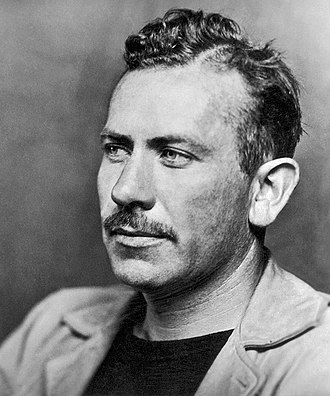 John Steinbeck
"An [hypertext] encyclopaedia will be an overall attempt by the knowledgeable, the learned societies or anyone else, to represent the state-of-the-art in their field. An encyclopaedia will be a living document, as up to date as it can be, instantly accessible at any time. It will contain carefully authored explanations and summaries of the subject, as well as computer-generated indexes of literature. A reference to a paper from the encyclopaedia conveys authority and acceptance by academic society. A measure of a paper’s standing may be conveyed by the number of links it is away from an encyclopaedia."
 Tim Berners-Lee
"One of the first major steps in the direction of modern skepticism came through the victory of Occam over Aquinas in a controversy about language. The statement that modi essendi were replaced by modi significandi et intelligendi, or that ontological referents were abandoned in favor of pragmatic significations, describes broadly the change in philosophy which continues to our time. From Occam to Bacon, from Bacon to Hobbes, and from Hobbes to contemporary semanticists, the progression is clear: ideas become psychological figments, words become useful signs. ... To one completely committed to this realm of becoming, as are the empiricists, the claim to apprehend verities is a sign of . Probably we have here but a highly sophisticated expression of the doctrine that ideals are hallucination and that the only normal, sane person is the healthy extrovert, making instant, instinctive adjustments to the stimuli of the material world."