Quote
"I dont think the war in Afghanistan was ruthlessly enough waged."
C
Christopher Hitchens"A double problem arises: There is first the difficulty of, if not the impossibility of demonstrating the existence of any creator or designer at all. I think I say something uncontroversial when I say that no theologian has ever conclusively demonstrated that such a designer can or does or ever has existed. The most you can do, by way of the argument from design, is to infer him or her or it from an apparent harmony in the arrangements - and this was at a time when that was the very best that, so to speak, could be done. But religion goes a little further than this already rather impossible task, and expects us to believe as follows: that the speaker not only can prove the existence of a said entity, but can claim to know this entitys mind - in fact, can claim to know it quite intimately; can claim to know his or her personal wishes; can, in turn, tell you what you may do, in his name - a quite large arrogation of power, you will suddenly notice, is being granted to the speaker here. The speaker can tell you that he knows - he cannot tell you how - but he can tell you that he knows, for example, that heaven hates ham, that god doesnt want you to eat pork products; he can tell you that god has a very very strong view about with whom you may have sexual relations, indeed, how you may have sexual relations with others; he can indicate, perhaps a little less convincingly but no less firmly, that there are certain books or courses of study that you might want to avoid or treat with great suspicion.”"
Christopher Eric Hitchens was a British and American author and journalist. Known as one of the "Four Horsemen" of New Atheism, he gained prominence as a columnist and speaker. His epistemological razor, which states that "what can be asserted without evidence can also be dismissed without evidence", is used in philosophy and law.
"I dont think the war in Afghanistan was ruthlessly enough waged."
"An official of the Teamsters Union, asked by a Senate hearing if his union was really powerful, responded guardedly but elegantly by saying that being powerful was a little like being ladylike: "If you have to say you are, you probly aint."
"Only the force of American arms, or the extremely credible threat of that force, can bring a fresh face to power."
"Three words for those who want to put the Christ back in Christmas: Jingle Bell Rock."
"Because the man with many monikers in many ways embodies his country and because this election cycle is now so absurd, and so much up for grabs, it is unwise to exclude anything... The best guess has to be that heres a man who hates to be alone, who needs approval and reinforcement, who talks a better game than he plays, who is crude, hyperactive, emotional and optimistic."
"BUSH IS NOT GREAT (HES MARVELLOUS!)"
"In the life of the mass-order, the culture of the generality tends to conform to the demands of the average human being. Spirituality decays through being diffused among the masses when knowledge is impoverished in every possible way by rationalisation until it becomes accessible to the crude understanding of all."
"I say this to you because we Spaniards are a forgetful people, because we are used to living for the moment, because we do not look back, because we do not know how to see the chain of heroes, because we do not contemplate the sum of sacrifices."
 Francisco Franco
"Sharon Tate was my best friend. Once, we were roommates. She introduced me to my husband. She was the godmother to my baby daughter who is named for her. In the six years time that I knew her, she never said an unkind word about anyone."
"Long time to see. (VS: Tapion)"
"Most mathematicians prove what they can, von Neumann proves what he wants." Once in a discussion about the rapid growth of mathematics in modern times, von Neumann was heard to remark that whereas thirty years ago a mathematician could grasp all of mathematics, that is impossible today. Someone asked him: "What percentage of all mathematics might a person aspire to understand today?" Von Neumann went into one of his five-second thinking trances, and said: "About 28 percent."
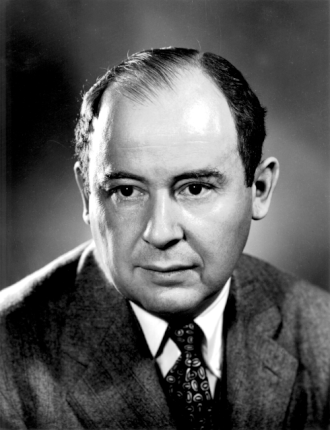 John von Neumann
"Children must be free to think in all directions irrespective of the peculiar ideas of parents who often seal their childrens minds with preconceived prejudices and false concepts of past generations. Unless we are very careful, very careful indeed, and very conscientious, there is still great danger that our children may turn out to be the same kind of people we are."