Quote
"Of the heat rays... sent... to a body by its surroundings a part are absorbed, the others are... varied by reflection and . The rays refracted and reflected... pass off... with those sent out by it, without... mutual disturbance..."
"A ... must have the same as the medium... then there will be no reflection at its surface, and all incident rays... wholly absorbed."

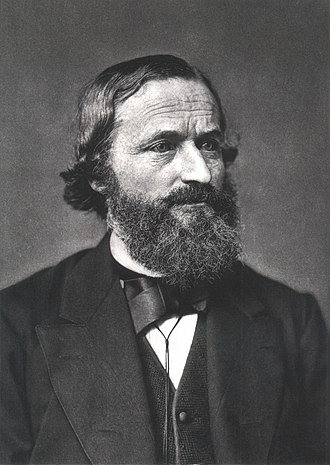
Gustav Robert Kirchhoff was a German physicist and mathematician who contributed to the fundamental understanding of electrical circuits, spectroscopy, and the emission of black-body radiation by heated objects. He coined the term black body in 1860.
"Of the heat rays... sent... to a body by its surroundings a part are absorbed, the others are... varied by reflection and . The rays refracted and reflected... pass off... with those sent out by it, without... mutual disturbance..."
"Through the radiations... a body sends out, the quantity of ... it contains will... sustain a loss... equivalent to the of those rays, and through the heat rays... it absorbs, a gain... equivalent to the vis viva of the absorbed rays."
"Conversely, upon the body there falls through the openings 2 and 1 a pencil of rays having the wave length \lambda, polarized in the plane a; of this, the body absorbs a part while it reflects or transmits the remainder; let the ratio of the intensity of the absorbed rays to the incident rays be A and let this be called the absorptive power of the body... The quantities E and A depend upon the nature of the condition of the body.., also upon the form and position of the openings.., the wave length \lambda and the direction of the plane a."
"Let E \partial \lambda be the intensity of the component polarized in a, or... [equivalently] the increase, which the vis viva of the ether beyond the screen S2 experiences through this component in the unit of time."
"Another result of this law... When a space is surrounded by bodies of the same temperature, and no rays can penetrate through these bodies, every pencil in the interior of the space is so constituted, with respect to its quality and intensity, as if it proceeded from a perfectly black body of the same temperature, and is therefore independent of the nature and form of the bodies, and only determined by the temperature. The truth... is evident if we consider that a pencil of rays, which has the same form, but the reverse direction to that chosen, is completely absorbed by the infinite number of reflections which it successively experiences at the assumed bodies. In the interior of an opaque glowing hollow body of given temperature there is, consequently, always the same brightness whatever its nature may be in other respects."
"Let a body which satisfies these conditions be surrounded by an enclosure, having the same temperature [and kept constant], through which no heat rays can penetrate... The body sends out heat rays and is encountered by... heat rays... in part... from the enclosure, in part... thrown back... by reflection from it, absorbing a part of them. Its temperature must thus remain the same, unless heat is withdrawn from it or communicated to it as follows on the principle from which Carnots law results. For this reason the vis viva of the rays, which it sends out in a certain time, must equal the vis viva of the rays which it absorbs in the same time."